CWE-434
AllowedUnrestricted Upload of File with Dangerous Type
Abstraction: Base · Status: Draft
The product allows the upload or transfer of dangerous file types that are automatically processed within its environment.
5971 vulnerabilities reference this CWE, most recent first.
GHSA-PW8M-QP4C-VV96
Vulnerability from github – Published: 2023-08-15 18:31 – Updated: 2024-04-04 06:58File Upload vulnerability in Wolf-leo EasyAdmin8 v.1.0 allows a remote attacker to execute arbtirary code via the upload type function.
{
  "affected": [],
  "aliases": [
    "CVE-2023-38915"
  ],
  "database_specific": {
    "cwe_ids": [
      "CWE-434"
    ],
    "github_reviewed": false,
    "github_reviewed_at": null,
    "nvd_published_at": "2023-08-15T17:15:12Z",
    "severity": "CRITICAL"
  },
  "details": "File Upload vulnerability in Wolf-leo EasyAdmin8 v.1.0 allows a remote attacker to execute arbtirary code via the upload type function.",
  "id": "GHSA-pw8m-qp4c-vv96",
  "modified": "2024-04-04T06:58:02Z",
  "published": "2023-08-15T18:31:32Z",
  "references": [
    {
      "type": "ADVISORY",
      "url": "https://nvd.nist.gov/vuln/detail/CVE-2023-38915"
    },
    {
      "type": "WEB",
      "url": "https://github.com/wolf-leo/EasyAdmin8/issues/1"
    }
  ],
  "schema_version": "1.4.0",
  "severity": [
    {
      "score": "CVSS:3.1/AV:N/AC:L/PR:N/UI:N/S:U/C:H/I:H/A:H",
      "type": "CVSS_V3"
    }
  ]
}
GHSA-PW97-GRW5-HP3H
Vulnerability from github – Published: 2024-08-06 03:30 – Updated: 2024-08-06 03:30The CRM Perks Forms plugin for WordPress is vulnerable to arbitrary file uploads due to insufficient file validation on the 'handle_uploaded_files' function in versions up to, and including, 1.1.3. This makes it possible for authenticated attackers with administrator-level capabilities or above, to upload arbitrary files on the affected site's server which may make remote code execution possible.
{
  "affected": [],
  "aliases": [
    "CVE-2024-7484"
  ],
  "database_specific": {
    "cwe_ids": [
      "CWE-434"
    ],
    "github_reviewed": false,
    "github_reviewed_at": null,
    "nvd_published_at": "2024-08-06T02:15:35Z",
    "severity": "HIGH"
  },
  "details": "The CRM Perks Forms plugin for WordPress is vulnerable to arbitrary file uploads due to insufficient file validation on the \u0027handle_uploaded_files\u0027 function in versions up to, and including, 1.1.3. This makes it possible for authenticated attackers with administrator-level capabilities or above, to upload arbitrary files on the affected site\u0027s server which may make remote code execution possible.",
  "id": "GHSA-pw97-grw5-hp3h",
  "modified": "2024-08-06T03:30:50Z",
  "published": "2024-08-06T03:30:50Z",
  "references": [
    {
      "type": "ADVISORY",
      "url": "https://nvd.nist.gov/vuln/detail/CVE-2024-7484"
    },
    {
      "type": "WEB",
      "url": "https://plugins.trac.wordpress.org/browser/crm-perks-forms/trunk/includes/front-form.php?rev=3003885#L3271"
    },
    {
      "type": "WEB",
      "url": "https://plugins.trac.wordpress.org/changeset/3016768/crm-perks-forms"
    },
    {
      "type": "WEB",
      "url": "https://www.wordfence.com/threat-intel/vulnerabilities/id/02c6ec97-50cc-4c61-9bb7-b94250d5dda3?source=cve"
    }
  ],
  "schema_version": "1.4.0",
  "severity": [
    {
      "score": "CVSS:3.1/AV:N/AC:L/PR:H/UI:N/S:U/C:H/I:H/A:H",
      "type": "CVSS_V3"
    }
  ]
}
GHSA-PWC6-45QR-9764
Vulnerability from github – Published: 2024-08-18 21:31 – Updated: 2024-08-18 21:31A vulnerability was found in CodeAstro Online Railway Reservation System 1.0 and classified as critical. Affected by this issue is some unknown functionality of the file /admin/emp-profile-avatar.php of the component Profile Photo Update Handler. The manipulation leads to unrestricted upload. The attack may be launched remotely. The exploit has been disclosed to the public and may be used.
{
  "affected": [],
  "aliases": [
    "CVE-2024-7910"
  ],
  "database_specific": {
    "cwe_ids": [
      "CWE-434"
    ],
    "github_reviewed": false,
    "github_reviewed_at": null,
    "nvd_published_at": "2024-08-18T19:15:05Z",
    "severity": "MODERATE"
  },
  "details": "A vulnerability was found in CodeAstro Online Railway Reservation System 1.0 and classified as critical. Affected by this issue is some unknown functionality of the file /admin/emp-profile-avatar.php of the component Profile Photo Update Handler. The manipulation leads to unrestricted upload. The attack may be launched remotely. The exploit has been disclosed to the public and may be used.",
  "id": "GHSA-pwc6-45qr-9764",
  "modified": "2024-08-18T21:31:07Z",
  "published": "2024-08-18T21:31:07Z",
  "references": [
    {
      "type": "ADVISORY",
      "url": "https://nvd.nist.gov/vuln/detail/CVE-2024-7910"
    },
    {
      "type": "WEB",
      "url": "https://github.com/CYB84/CVE_Writeup/blob/main/Online%20Railway%20Reservation%20System/RCE%20via%20File%20Upload.md"
    },
    {
      "type": "WEB",
      "url": "https://vuldb.com/?ctiid.275036"
    },
    {
      "type": "WEB",
      "url": "https://vuldb.com/?id.275036"
    },
    {
      "type": "WEB",
      "url": "https://vuldb.com/?submit.391650"
    }
  ],
  "schema_version": "1.4.0",
  "severity": [
    {
      "score": "CVSS:3.1/AV:N/AC:L/PR:H/UI:N/S:U/C:L/I:L/A:L",
      "type": "CVSS_V3"
    },
    {
      "score": "CVSS:4.0/AV:N/AC:L/AT:N/PR:H/UI:N/VC:L/VI:L/VA:L/SC:N/SI:N/SA:N/E:X/CR:X/IR:X/AR:X/MAV:X/MAC:X/MAT:X/MPR:X/MUI:X/MVC:X/MVI:X/MVA:X/MSC:X/MSI:X/MSA:X/S:X/AU:X/R:X/V:X/RE:X/U:X",
      "type": "CVSS_V4"
    }
  ]
}
GHSA-PWCF-2VX7-6RQV
Vulnerability from github – Published: 2026-03-05 06:30 – Updated: 2026-03-05 21:30Unrestricted Upload of File with Dangerous Type vulnerability in firassaidi WooCommerce License Manager fs-license-manager allows Upload a Web Shell to a Web Server.This issue affects WooCommerce License Manager: from n/a through <= 7.0.6.
{
  "affected": [],
  "aliases": [
    "CVE-2026-28114"
  ],
  "database_specific": {
    "cwe_ids": [
      "CWE-434"
    ],
    "github_reviewed": false,
    "github_reviewed_at": null,
    "nvd_published_at": "2026-03-05T06:16:45Z",
    "severity": "CRITICAL"
  },
  "details": "Unrestricted Upload of File with Dangerous Type vulnerability in firassaidi WooCommerce License Manager fs-license-manager allows Upload a Web Shell to a Web Server.This issue affects WooCommerce License Manager: from n/a through \u003c= 7.0.6.",
  "id": "GHSA-pwcf-2vx7-6rqv",
  "modified": "2026-03-05T21:30:44Z",
  "published": "2026-03-05T06:30:30Z",
  "references": [
    {
      "type": "ADVISORY",
      "url": "https://nvd.nist.gov/vuln/detail/CVE-2026-28114"
    },
    {
      "type": "WEB",
      "url": "https://patchstack.com/database/Wordpress/Plugin/fs-license-manager/vulnerability/wordpress-woocommerce-license-manager-plugin-6-0-5-arbitrary-file-upload-vulnerability?_s_id=cve"
    }
  ],
  "schema_version": "1.4.0",
  "severity": [
    {
      "score": "CVSS:3.1/AV:N/AC:L/PR:H/UI:N/S:C/C:H/I:H/A:H",
      "type": "CVSS_V3"
    }
  ]
}
GHSA-PWCR-FJCV-Q783
Vulnerability from github – Published: 2025-03-19 18:30 – Updated: 2025-03-19 21:30An arbitrary file upload vulnerability in the component /admin/template.php of emlog pro 2.5.0 and pro 2.5.* allows attackers to execute arbitrary code via uploading a crafted PHP file.
{
  "affected": [],
  "aliases": [
    "CVE-2025-29405"
  ],
  "database_specific": {
    "cwe_ids": [
      "CWE-434"
    ],
    "github_reviewed": false,
    "github_reviewed_at": null,
    "nvd_published_at": "2025-03-19T18:15:25Z",
    "severity": "MODERATE"
  },
  "details": "An arbitrary file upload vulnerability in the component /admin/template.php of emlog pro 2.5.0 and pro 2.5.* allows attackers to execute arbitrary code via uploading a crafted PHP file.",
  "id": "GHSA-pwcr-fjcv-q783",
  "modified": "2025-03-19T21:30:52Z",
  "published": "2025-03-19T18:30:52Z",
  "references": [
    {
      "type": "ADVISORY",
      "url": "https://nvd.nist.gov/vuln/detail/CVE-2025-29405"
    },
    {
      "type": "WEB",
      "url": "https://gist.github.com/bGl1o/19a141ee6e899884fa85f3a52898bcc6"
    },
    {
      "type": "WEB",
      "url": "https://github.com/bGl1o/emlogpro/blob/main/emlog%20pro2.5.7-getshell-2.md"
    }
  ],
  "schema_version": "1.4.0",
  "severity": [
    {
      "score": "CVSS:3.1/AV:N/AC:L/PR:H/UI:R/S:U/C:H/I:L/A:L",
      "type": "CVSS_V3"
    }
  ]
}
GHSA-PWF8-74XG-4P7M
Vulnerability from github – Published: 2024-10-16 09:30 – Updated: 2024-10-16 09:30The ZoomSounds plugin for WordPress is vulnerable to arbitrary file uploads due to missing file type validation in the 'savepng.php' file in versions up to, and including, 5.96. This makes it possible for unauthenticated attackers to upload arbitrary files on the affected site's server which may make remote code execution possible.
{
  "affected": [],
  "aliases": [
    "CVE-2021-4449"
  ],
  "database_specific": {
    "cwe_ids": [
      "CWE-434"
    ],
    "github_reviewed": false,
    "github_reviewed_at": null,
    "nvd_published_at": "2024-10-16T07:15:11Z",
    "severity": "CRITICAL"
  },
  "details": "The ZoomSounds plugin for WordPress is vulnerable to arbitrary file uploads due to missing file type validation in the \u0027savepng.php\u0027 file in versions up to, and including, 5.96. This makes it possible for unauthenticated attackers to upload arbitrary files on the affected site\u0027s server which may make remote code execution possible.",
  "id": "GHSA-pwf8-74xg-4p7m",
  "modified": "2024-10-16T09:30:30Z",
  "published": "2024-10-16T09:30:30Z",
  "references": [
    {
      "type": "ADVISORY",
      "url": "https://nvd.nist.gov/vuln/detail/CVE-2021-4449"
    },
    {
      "type": "WEB",
      "url": "https://codecanyon.net/item/zoomsounds-wordpress-wave-audio-player-with-playlist/6181433"
    },
    {
      "type": "WEB",
      "url": "https://github.com/0xAgun/Arbitrary-File-Upload-ZoomSounds"
    },
    {
      "type": "WEB",
      "url": "https://ithemes.com/blog/wordpress-vulnerability-report-june-2021-part-5/#ib-toc-anchor-2"
    },
    {
      "type": "WEB",
      "url": "https://sploitus.com/exploit?id=WPEX-ID:07259A61-8BA9-4DD0-8D52-CC1DF389C0AD"
    },
    {
      "type": "WEB",
      "url": "https://wpscan.com/vulnerability/07259a61-8ba9-4dd0-8d52-cc1df389c0ad"
    },
    {
      "type": "WEB",
      "url": "https://www.wordfence.com/threat-intel/vulnerabilities/id/262e3bb3-bc83-4d0b-8056-9f94ec141b8f?source=cve"
    }
  ],
  "schema_version": "1.4.0",
  "severity": [
    {
      "score": "CVSS:3.1/AV:N/AC:L/PR:N/UI:N/S:U/C:H/I:H/A:H",
      "type": "CVSS_V3"
    }
  ]
}
GHSA-PWG9-VP4W-MC97
Vulnerability from github – Published: 2026-05-20 03:31 – Updated: 2026-06-23 03:31The ProSolution WP Client plugin for WordPress is vulnerable to Arbitrary File Upload in versions up to, and including, 2.0.0. This is due to an array validation mismatch where only the first file in the upload array undergoes extension and MIME type validation, while all files are processed and uploaded to a web-accessible directory. This makes it possible for unauthenticated attackers to upload malicious PHP files and achieve remote code execution by sending a valid first file followed by a malicious file.
{
  "affected": [],
  "aliases": [
    "CVE-2026-6555"
  ],
  "database_specific": {
    "cwe_ids": [
      "CWE-434"
    ],
    "github_reviewed": false,
    "github_reviewed_at": null,
    "nvd_published_at": "2026-05-20T02:16:38Z",
    "severity": "CRITICAL"
  },
  "details": "The ProSolution WP Client plugin for WordPress is vulnerable to Arbitrary File Upload in versions up to, and including, 2.0.0. This is due to an array validation mismatch where only the first file in the upload array undergoes extension and MIME type validation, while all files are processed and uploaded to a web-accessible directory. This makes it possible for unauthenticated attackers to upload malicious PHP files and achieve remote code execution by sending a valid first file followed by a malicious file.",
  "id": "GHSA-pwg9-vp4w-mc97",
  "modified": "2026-06-23T03:31:41Z",
  "published": "2026-05-20T03:31:34Z",
  "references": [
    {
      "type": "ADVISORY",
      "url": "https://nvd.nist.gov/vuln/detail/CVE-2026-6555"
    },
    {
      "type": "WEB",
      "url": "https://plugins.trac.wordpress.org/browser/prosolution-wp-client/tags/2.0.0/includes/UploadHandler.php#L1345"
    },
    {
      "type": "WEB",
      "url": "https://plugins.trac.wordpress.org/browser/prosolution-wp-client/tags/2.0.0/includes/UploadHandler.php#L384"
    },
    {
      "type": "WEB",
      "url": "https://plugins.trac.wordpress.org/browser/prosolution-wp-client/tags/2.0.0/public/class-prosolwpclient-public.php#L1072"
    },
    {
      "type": "WEB",
      "url": "https://plugins.trac.wordpress.org/browser/prosolution-wp-client/tags/2.0.0/public/class-prosolwpclient-public.php#L998"
    },
    {
      "type": "WEB",
      "url": "https://plugins.trac.wordpress.org/browser/prosolution-wp-client/trunk/includes/UploadHandler.php#L1345"
    },
    {
      "type": "WEB",
      "url": "https://plugins.trac.wordpress.org/browser/prosolution-wp-client/trunk/includes/UploadHandler.php#L384"
    },
    {
      "type": "WEB",
      "url": "https://plugins.trac.wordpress.org/browser/prosolution-wp-client/trunk/public/class-prosolwpclient-public.php#L1072"
    },
    {
      "type": "WEB",
      "url": "https://plugins.trac.wordpress.org/browser/prosolution-wp-client/trunk/public/class-prosolwpclient-public.php#L998"
    },
    {
      "type": "WEB",
      "url": "https://plugins.trac.wordpress.org/changeset/3535622"
    },
    {
      "type": "WEB",
      "url": "https://www.wordfence.com/threat-intel/vulnerabilities/id/0b870d35-7e10-4fb5-8c3b-2bf299d1f3d5?source=cve"
    }
  ],
  "schema_version": "1.4.0",
  "severity": [
    {
      "score": "CVSS:3.1/AV:N/AC:L/PR:N/UI:N/S:U/C:H/I:H/A:H",
      "type": "CVSS_V3"
    }
  ]
}
GHSA-PWGQ-6599-QFPV
Vulnerability from github – Published: 2023-05-20 12:30 – Updated: 2024-04-04 04:15Unrestricted Upload of File with Dangerous Type vulnerability in "Rental Module" developed by third-party for Ideasoft's E-commerce Platform allows Command Injection, Using Malicious Files, Upload a Web Shell to a Web Server.This issue affects Rental Module: before 23.05.15.
{
  "affected": [],
  "aliases": [
    "CVE-2023-2712"
  ],
  "database_specific": {
    "cwe_ids": [
      "CWE-434"
    ],
    "github_reviewed": false,
    "github_reviewed_at": null,
    "nvd_published_at": "2023-05-20T10:15:09Z",
    "severity": "CRITICAL"
  },
  "details": "Unrestricted Upload of File with Dangerous Type vulnerability  in \"Rental Module\" developed by third-party for Ideasoft\u0027s E-commerce Platform allows Command Injection, Using Malicious Files, Upload a Web Shell to a Web Server.This issue affects Rental Module: before 23.05.15.\n\n",
  "id": "GHSA-pwgq-6599-qfpv",
  "modified": "2024-04-04T04:15:36Z",
  "published": "2023-05-20T12:30:24Z",
  "references": [
    {
      "type": "ADVISORY",
      "url": "https://nvd.nist.gov/vuln/detail/CVE-2023-2712"
    },
    {
      "type": "WEB",
      "url": "https://www.usom.gov.tr/bildirim/tr-23-0276"
    }
  ],
  "schema_version": "1.4.0",
  "severity": [
    {
      "score": "CVSS:3.1/AV:N/AC:L/PR:N/UI:N/S:C/C:H/I:H/A:H",
      "type": "CVSS_V3"
    }
  ]
}
GHSA-PWH2-FPFR-X5GF
Vulnerability from github – Published: 2024-03-25 19:46 – Updated: 2024-03-25 22:28Summary
The category image upload function in phpmyfaq is vulnerable to manipulation of the Content-type and lang parameters, allowing attackers to upload malicious files with a .php extension, potentially leading to remote code execution (RCE) on the system.
Details
In the file upload function of the category image, the Content-type can be manipulated to return an empty string for the extension and the lang parameter can be set to .php. to allow an attacker to save a file as .PHP. This allows the uploading of web shells which could lead to RCE on phpmyfaq.
PoC
-
Generate a fake .GIF file that contains a php command using the tool
gifsiclea. Cmd:gifsicle < test1.gif --comment "<?php system('whoami'); ?>" > output.php.gifb. The contents of the file should look like this:
-
Browse to “../phpmyfaq/admin/?action=addcategory” and upload the fake .GIF file
-
Intercept the upload request and modify the params below and forward it: 3a.
langparameter to.php.3b.Content-Typeparameter fromimage/giftoimage/gif2 -
Browse to the “/phpmyfaq/images” directory and notice that our fake .GIF file has been uploaded as a PHP file with the category number as its filename.
-
Now we just need to browse to “../phpmyfaq/images/category--.php” and see the results of our whoami command. Hence, verifying that RCE is achieved.
Impact
Attackers can upload malicious files containing executable code, allowing them to take control of the vulnerable system. This enables them to execute arbitrary commands, steal sensitive data, disrupt services, and potentially escalate their privileges, posing significant risks to the security and integrity of the system and its data.
Occurrences
In CategoryImage.php line 124, the getimagesize and isValidMimeType functions can be bypassed by uploading a fake .GIF file generated by gifsicle.
In CategoryImage.php line 85, the getFileExtension function returns an empty string when the content type doesnt match any of the following 3 mappings. Hence, its possible to just supply an invalid content type such as image/gif2 in step 3 of the PoC to make the function return an empty string.
In CategoryImage.php line 66, the getFileName function generate the filename by concatenating the categoryId, categoryName and fileExtension together. This allows us to save the file with a .PHP extension. (It should be possible to just set the payload in step 3 above to just .php but it doesnt work and im not sure why..)
Suggested Fix
I believe one of the ways to solve this vulnerability is by forcing the getFileExtension function to return one of the 3 mimetype instead of an empty string. This ensures that the uploaded file will have an image extension and will not execute as a PHP file.
{
"affected": [
{
"package": {
"ecosystem": "Packagist",
"name": "phpmyfaq/phpmyfaq"
},
"ranges": [
{
"events": [
{
"introduced": "3.2.5"
},
{
"fixed": "3.2.6"
}
],
"type": "ECOSYSTEM"
}
],
"versions": [
"3.2.5"
]
}
],
"aliases": [
"CVE-2024-28105"
],
"database_specific": {
"cwe_ids": [
"CWE-434"
],
"github_reviewed": true,
"github_reviewed_at": "2024-03-25T19:46:11Z",
"nvd_published_at": "2024-03-25T19:15:58Z",
"severity": "HIGH"
},
"details": "### Summary\nThe category image upload function in phpmyfaq is vulnerable to manipulation of the `Content-type` and `lang` parameters, allowing attackers to upload malicious files with a .php extension, potentially leading to remote code execution (RCE) on the system.\n\n### Details\nIn the file upload function of the category image, the `Content-type` can be manipulated to return an empty string for the extension and the `lang` parameter can be set to `.php.` to allow an attacker to save a file as `.PHP`. This allows the uploading of web shells which could lead to RCE on phpmyfaq.\n\n### PoC\n1. Generate a fake .GIF file that contains a php command using the tool `gifsicle`\n a. Cmd: `gifsicle \u003c test1.gif --comment \"\u003c?php system(\u0027whoami\u0027); ?\u003e\" \u003e output.php.gif`\n \n \n\n b. The contents of the file should look like this: \n \n\n2. Browse to \u201c../phpmyfaq/admin/?action=addcategory\u201d and upload the fake .GIF file\n 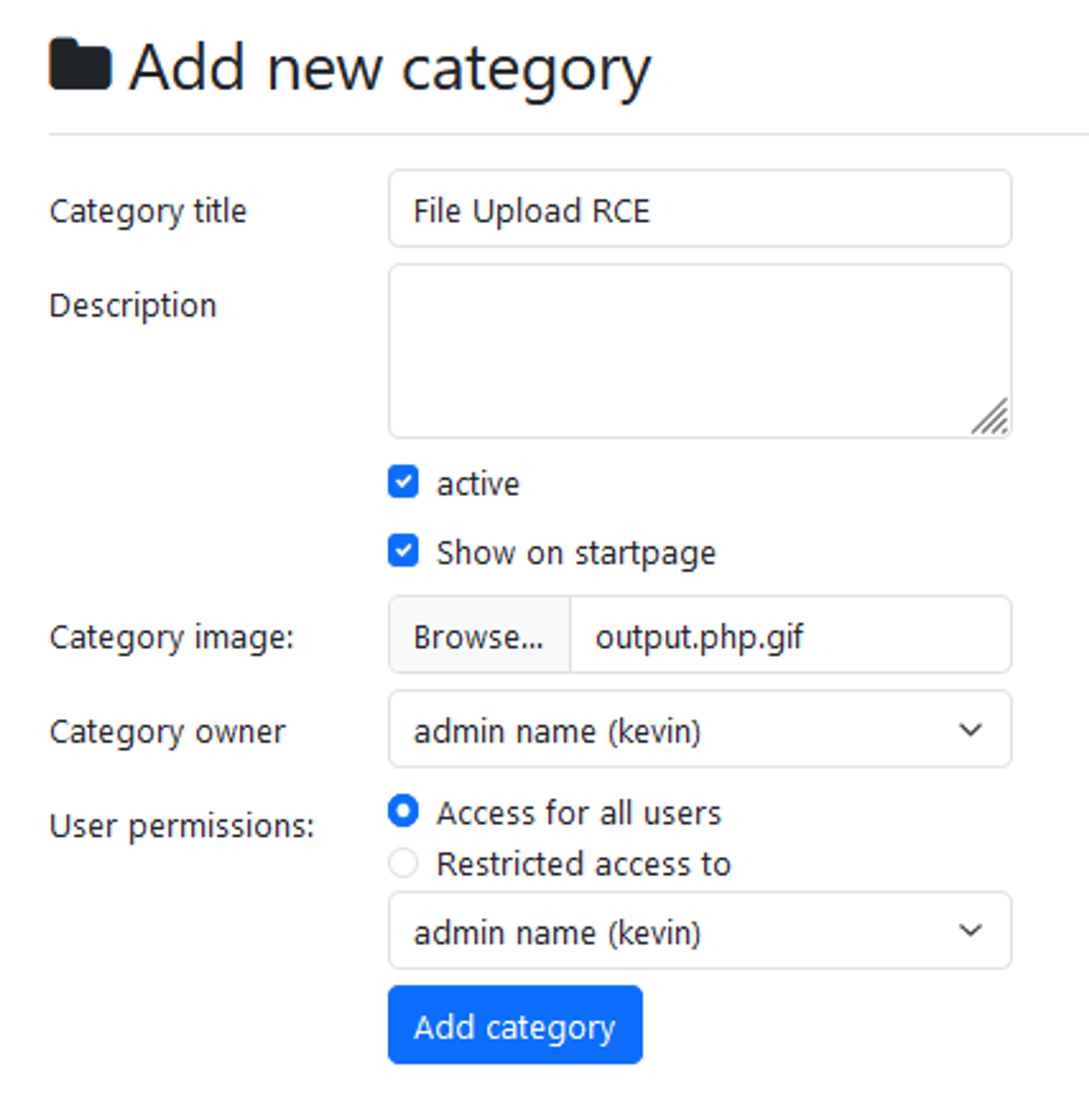\n\n3. Intercept the upload request and modify the params below and forward it:\n 3a. `lang` parameter to `.php.`\n 3b. `Content-Type` parameter from `image/gif` to `image/gif2`\n\n 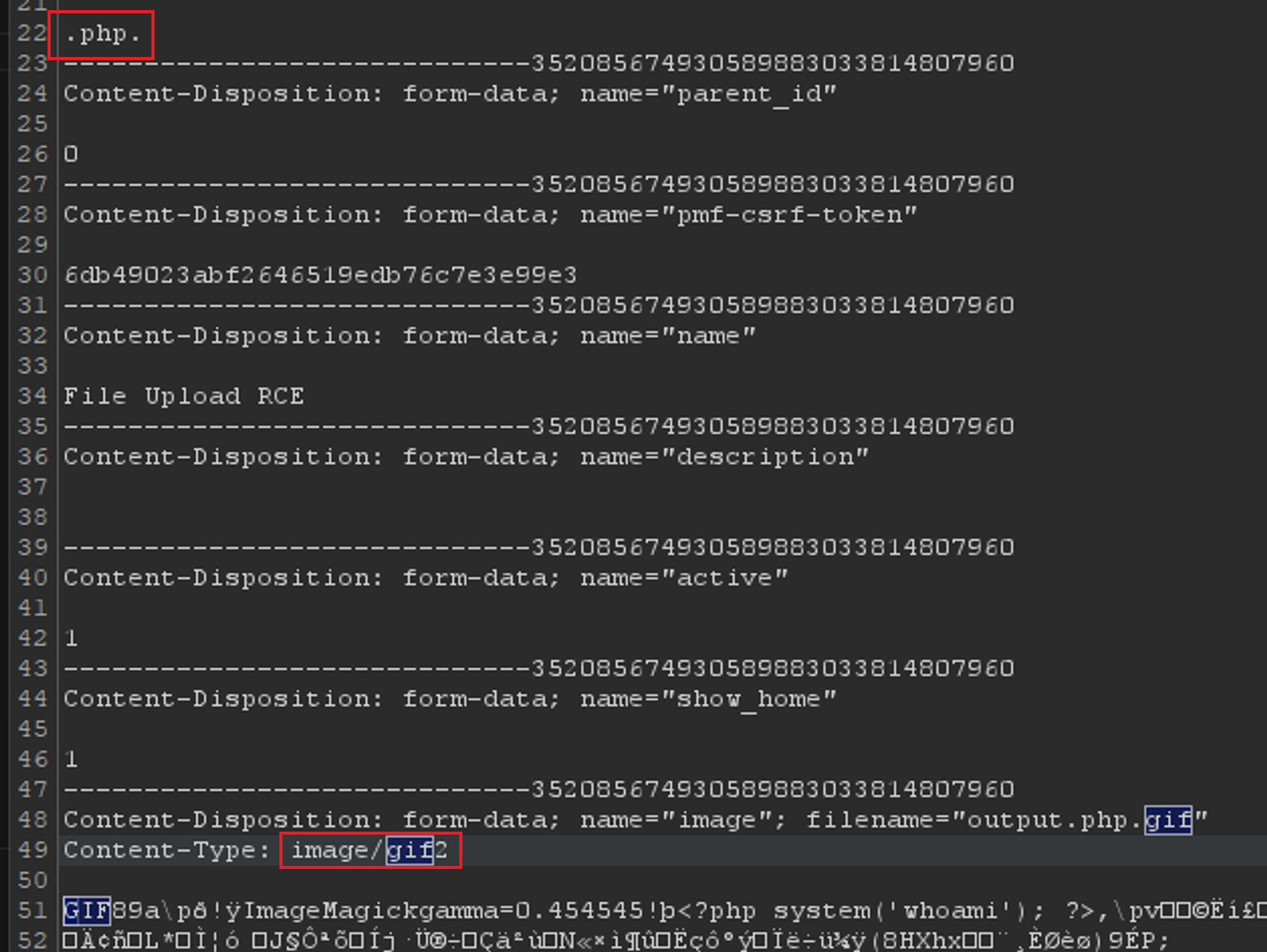\n\n4. Browse to the \u201c/phpmyfaq/images\u201d directory and notice that our fake .GIF file has been uploaded as a PHP file with the category number as its filename.\n 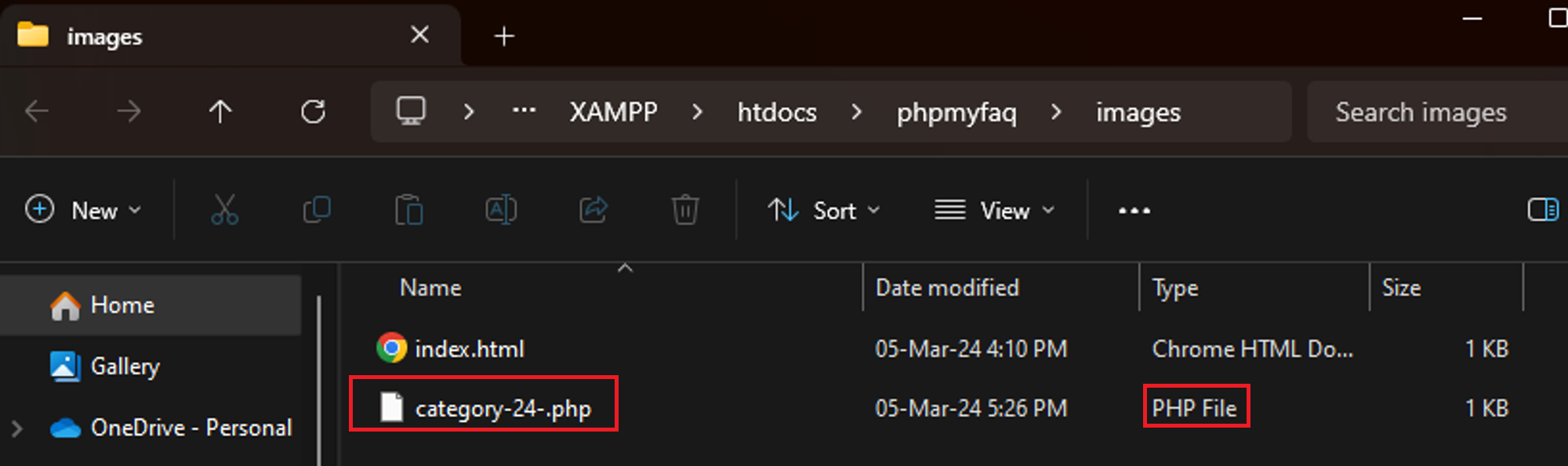\n\n5. Now we just need to browse to \u201c../phpmyfaq/images/category-\u003cID\u003e-.php\u201d and see the results of our whoami command. Hence, verifying that RCE is achieved.\n \n\n### Impact\nAttackers can upload malicious files containing executable code, allowing them to take control of the vulnerable system. This enables them to execute arbitrary commands, steal sensitive data, disrupt services, and potentially escalate their privileges, posing significant risks to the security and integrity of the system and its data.\n\n### Occurrences\nIn CategoryImage.php line 124, the getimagesize and isValidMimeType functions can be bypassed by uploading a fake .GIF file generated by gifsicle. \n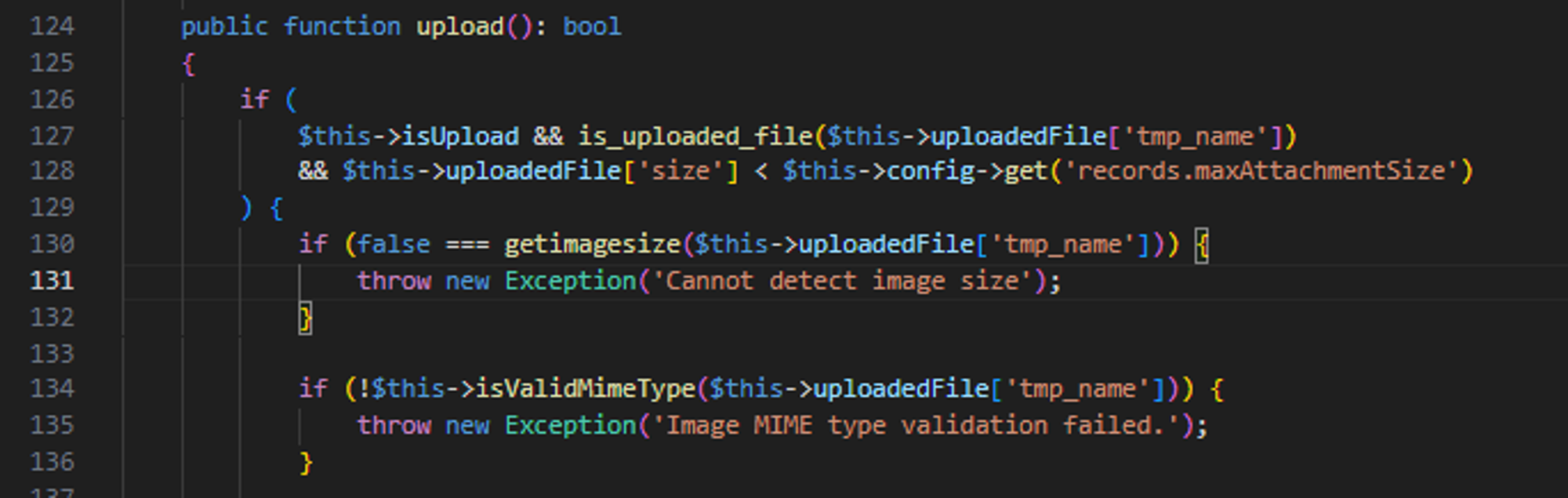\n\nIn CategoryImage.php line 85, the getFileExtension function returns an empty string when the content type doesnt match any of the following 3 mappings. Hence, its possible to just supply an invalid content type such as image/gif2 in step 3 of the PoC to make the function return an empty string. \n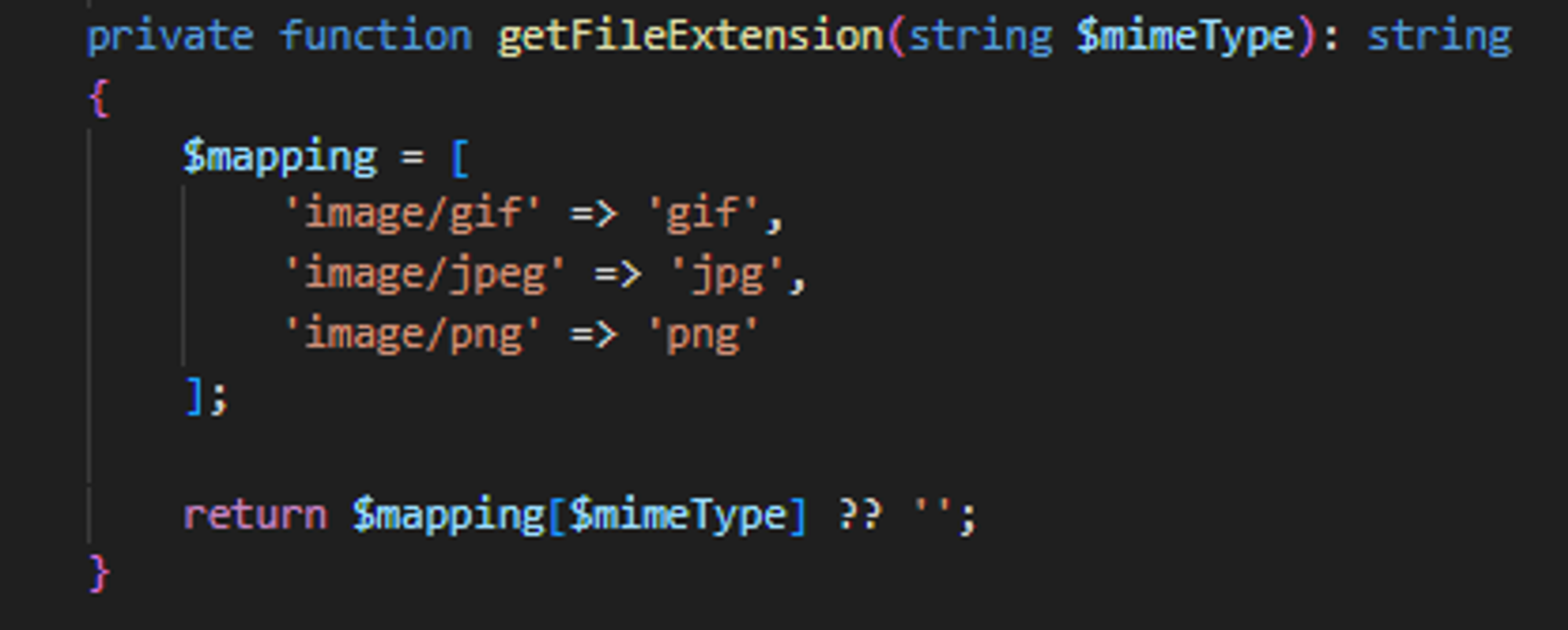\n\nIn CategoryImage.php line 66, the getFileName function generate the filename by concatenating the categoryId, categoryName and fileExtension together. This allows us to save the file with a .PHP extension. (It should be possible to just set the payload in step 3 above to just .php but it doesnt work and im not sure why..)\n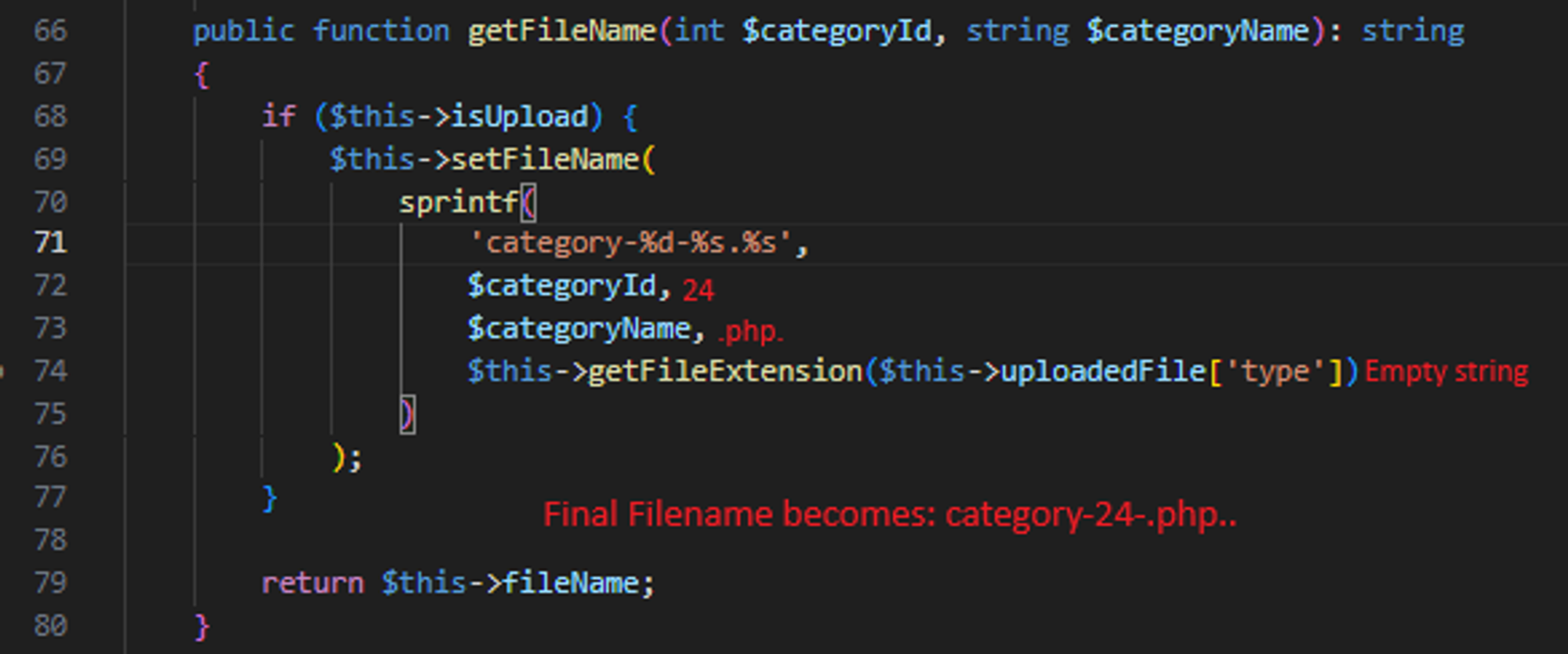\n\n### Suggested Fix\nI believe one of the ways to solve this vulnerability is by forcing the getFileExtension function to return one of the 3 mimetype instead of an empty string. This ensures that the uploaded file will have an image extension and will not execute as a PHP file.",
"id": "GHSA-pwh2-fpfr-x5gf",
"modified": "2024-03-25T22:28:15Z",
"published": "2024-03-25T19:46:11Z",
"references": [
{
"type": "WEB",
"url": "https://github.com/thorsten/phpMyFAQ/security/advisories/GHSA-pwh2-fpfr-x5gf"
},
{
"type": "ADVISORY",
"url": "https://nvd.nist.gov/vuln/detail/CVE-2024-28105"
},
{
"type": "WEB",
"url": "https://github.com/thorsten/phpMyFAQ/commit/9136883776af67dfdb0e8cf14f5e0ca22bf4f2e7"
},
{
"type": "PACKAGE",
"url": "https://github.com/thorsten/phpMyFAQ"
}
],
"schema_version": "1.4.0",
"severity": [
{
"score": "CVSS:3.1/AV:N/AC:L/PR:H/UI:N/S:U/C:H/I:H/A:H",
"type": "CVSS_V3"
}
],
"summary": "phpMyFAQ\u0027s File Upload Bypass at Category Image Leads to RCE"
}
GHSA-PWHF-39XG-4RXW
Vulnerability from github – Published: 2021-06-04 19:09 – Updated: 2021-06-04 19:23Impact
A malicious internal actor is able to upload documentation content with malicious scripts. These scripts would normally be sanitized by the TechDocs frontend, but by tricking a user to visit the content via the TechDocs API, the content sanitazion will be bypassed. If the TechDocs API is hosted on the same origin as the Backstage app or other backend plugins, this may give access to sensitive data.
The ability to upload malicious content may be limited by internal code review processes, unless the chosen TechDocs deployment method is to use an object store and the actor has access to upload files directly to that store.
Patches
The vulnerability is patched in the 0.6.4 release of @backstage/techdocs-common.
For more information
If you have any questions or comments about this advisory:
- Open an issue in the Backstage repository
- Visit our chat, linked to in Backstage README
{
  "affected": [
    {
      "package": {
        "ecosystem": "npm",
        "name": "@backstage/techdocs-common"
      },
      "ranges": [
        {
          "events": [
            {
              "introduced": "0"
            },
            {
              "fixed": "0.6.4"
            }
          ],
          "type": "ECOSYSTEM"
        }
      ]
    }
  ],
  "aliases": [
    "CVE-2021-32660"
  ],
  "database_specific": {
    "cwe_ids": [
      "CWE-434",
      "CWE-77"
    ],
    "github_reviewed": true,
    "github_reviewed_at": "2021-06-03T22:02:53Z",
    "nvd_published_at": "2021-06-03T17:15:00Z",
    "severity": "MODERATE"
  },
  "details": "### Impact\n\nA malicious internal actor is able to upload documentation content with malicious scripts. These scripts would normally be sanitized by the TechDocs frontend, but by tricking a user to visit the content via the TechDocs API, the content sanitazion will be bypassed. If the TechDocs API is hosted on the same origin as the Backstage app or other backend plugins, this may give access to sensitive data.\n\nThe ability to upload malicious content may be limited by internal code review processes, unless the chosen TechDocs deployment method is to use an object store and the actor has access to upload files directly to that store.\n\n### Patches\n\nThe vulnerability is patched in the `0.6.4` release of `@backstage/techdocs-common`.\n\n### For more information\n\nIf you have any questions or comments about this advisory:\n\n* Open an issue in the [Backstage repository](https://github.com/backstage/backstage)\n* Visit our chat, linked to in [Backstage README](https://github.com/backstage/backstage)",
  "id": "GHSA-pwhf-39xg-4rxw",
  "modified": "2021-06-04T19:23:33Z",
  "published": "2021-06-04T19:09:35Z",
  "references": [
    {
      "type": "WEB",
      "url": "https://github.com/backstage/backstage/security/advisories/GHSA-pwhf-39xg-4rxw"
    },
    {
      "type": "ADVISORY",
      "url": "https://nvd.nist.gov/vuln/detail/CVE-2021-32660"
    },
    {
      "type": "WEB",
      "url": "https://github.com/backstage/backstage/commit/aad98c544e59369901fe9e0a85f6357644dceb5c"
    },
    {
      "type": "WEB",
      "url": "https://github.com/backstage/backstage/releases/tag/release-2021-06-03"
    }
  ],
  "schema_version": "1.4.0",
  "severity": [
    {
      "score": "CVSS:3.1/AV:N/AC:L/PR:H/UI:R/S:U/C:H/I:H/A:H",
      "type": "CVSS_V3"
    }
  ],
  "summary": "Script injection"
}
Mitigation
Generate a new, unique filename for an uploaded file instead of using the user-supplied filename, so that no external input is used at all.[REF-422] [REF-423]
Mitigation MIT-21
Strategy: Enforcement by Conversion
When the set of acceptable objects, such as filenames or URLs, is limited or known, create a mapping from a set of fixed input values (such as numeric IDs) to the actual filenames or URLs, and reject all other inputs.
Mitigation
Consider storing the uploaded files outside of the web document root entirely. Then, use other mechanisms to deliver the files dynamically. [REF-423]
Mitigation MIT-5
Strategy: Input Validation
- Assume all input is malicious. Use an "accept known good" input validation strategy, i.e., use a list of acceptable inputs that strictly conform to specifications. Reject any input that does not strictly conform to specifications, or transform it into something that does.
- When performing input validation, consider all potentially relevant properties, including length, type of input, the full range of acceptable values, missing or extra inputs, syntax, consistency across related fields, and conformance to business rules. As an example of business rule logic, "boat" may be syntactically valid because it only contains alphanumeric characters, but it is not valid if the input is only expected to contain colors such as "red" or "blue."
- Do not rely exclusively on looking for malicious or malformed inputs. This is likely to miss at least one undesirable input, especially if the code's environment changes. This can give attackers enough room to bypass the intended validation. However, denylists can be useful for detecting potential attacks or determining which inputs are so malformed that they should be rejected outright.
- For example, limiting filenames to alphanumeric characters can help to restrict the introduction of unintended file extensions.
Mitigation
Define a very limited set of allowable extensions and only generate filenames that end in these extensions. Consider the possibility of XSS (CWE-79) before allowing .html or .htm file types.
Mitigation
Strategy: Input Validation
Ensure that only one extension is used in the filename. Some web servers, including some versions of Apache, may process files based on inner extensions so that "filename.php.gif" is fed to the PHP interpreter.[REF-422] [REF-423]
Mitigation
When running on a web server that supports case-insensitive filenames, perform case-insensitive evaluations of the extensions that are provided.
Mitigation MIT-15
For any security checks that are performed on the client side, ensure that these checks are duplicated on the server side, in order to avoid CWE-602. Attackers can bypass the client-side checks by modifying values after the checks have been performed, or by changing the client to remove the client-side checks entirely. Then, these modified values would be submitted to the server.
Mitigation
Do not rely exclusively on sanity checks of file contents to ensure that the file is of the expected type and size. It may be possible for an attacker to hide code in some file segments that will still be executed by the server. For example, GIF images may contain a free-form comments field.
Mitigation
Do not rely exclusively on the MIME content type or filename attribute when determining how to render a file. Validating the MIME content type and ensuring that it matches the extension is only a partial solution.
Mitigation MIT-17
Strategy: Environment Hardening
Run your code using the lowest privileges that are required to accomplish the necessary tasks [REF-76]. If possible, create isolated accounts with limited privileges that are only used for a single task. That way, a successful attack will not immediately give the attacker access to the rest of the software or its environment. For example, database applications rarely need to run as the database administrator, especially in day-to-day operations.
Mitigation MIT-22
Strategy: Sandbox or Jail
- Run the code in a "jail" or similar sandbox environment that enforces strict boundaries between the process and the operating system. This may effectively restrict which files can be accessed in a particular directory or which commands can be executed by the software.
- OS-level examples include the Unix chroot jail, AppArmor, and SELinux. In general, managed code may provide some protection. For example, java.io.FilePermission in the Java SecurityManager allows the software to specify restrictions on file operations.
- This may not be a feasible solution, and it only limits the impact to the operating system; the rest of the application may still be subject to compromise.
- Be careful to avoid CWE-243 and other weaknesses related to jails.
CAPEC-1: Accessing Functionality Not Properly Constrained by ACLs
In applications, particularly web applications, access to functionality is mitigated by an authorization framework. This framework maps Access Control Lists (ACLs) to elements of the application's functionality; particularly URL's for web apps. In the case that the administrator failed to specify an ACL for a particular element, an attacker may be able to access it with impunity. An attacker with the ability to access functionality not properly constrained by ACLs can obtain sensitive information and possibly compromise the entire application. Such an attacker can access resources that must be available only to users at a higher privilege level, can access management sections of the application, or can run queries for data that they otherwise not supposed to.